
When Dust Isn’t Just Dust
Jean Fong2026-06-24T08:32:15-07:00What BC manufacturers need to know about combustible dust — and how to protect your workers, facility, and operations.
Dust is one of the most common byproducts in BC manufacturing and food processing facilities. It shows up on shelves, equipment, and floors — and it gets cleaned up, swept away, and treated as routine. That framing can put workers and facilities at serious risk.
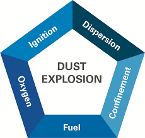
Not all dust is just a mess. Fine particles from materials like wood, grain, sugar, plastic, or metal are combustible under the right conditions. When these particles accumulate in the air or on surfaces, a single spark or heat source could trigger a fire — or something far worse.
Did you know?
Combustible dust incidents can result in two explosions. The first disturbs accumulated dust, sending a cloud into the air. The second — more destructive — is triggered when that airborne cloud ignites. Secondary explosions are responsible for many of the most serious workplace incidents involving dust.
Industries affected include wood products, food processing, grain handling, plastics, metal fabrication, and pharmaceuticals.

Why the Hazard Gets Overlooked
Dust is familiar. It’s always been there. Because most of the time nothing happens, it’s easy to treat it as routine. The problem is that combustible dust doesn’t announce itself as a hazard — it builds up quietly until conditions align: an accumulation on a surface, a sudden disturbance, an ignition source nearby.
For safety teams, this means the hazard often sits outside the traditional risk assessment lens. It looks like a housekeeping issue right up until it isn’t.
Two Types of Dust Hazards to Know About
Understanding where dust comes from in your facility is the first step.
- Process dust originates from the materials or machinery in your production line. It’s typically generated at a specific point — a saw, a grinder, a conveyor or transfer point — and can often be captured at the source.
- Fugitive dust escapes the process or control equipment and spreads through the facility. It’s often finer, drier, and more likely to settle on elevated surfaces like beams, ducts, cable trays, and equipment tops — exactly the places that are harder to clean and easier to overlook.
Both types contribute to risk. A thorough look at your facility should consider where dust is generated, how it moves, and where it accumulates — not just what’s visible at eye level.
5 Things to Check in Your Facility
You don’t need to be an engineer to start asking the right questions. Here are five practical places to begin.
- Accumulation on elevated surfaces. Look up. Beams, rafters, ductwork, and equipment tops are prime areas for dust to settle and build up unnoticed.
- Dust collection system performance. If your dust collector is running but conditions in the work area still seem dusty, it may be underperforming, poorly maintained, or not properly matched to your process.
- Ignition sources near dusty areas. Open flames from grinders or welders, hot surfaces, electrical equipment, and even static build-up can all serve as ignition sources if combustible dust is present.
- Housekeeping frequency and methods. Compressed air blowdown can send settled dust airborne and create a hazardous cloud. Wet methods or vacuuming with appropriate equipment are generally safer alternatives.
- What your dust is made of. Not all dusts carry the same risk level. Getting your specific dust tested is the most reliable way to understand how combustible it is — and what controls are most appropriate.
A Combination Approach Works Best
Effectively managing combustible dust may require both engineering controls and day-to-day operational practices working together.
Engineering controls address the source and spread of dust:
- Dust collection systems designed for your specific process and materials
- Source capture — removing dust at the point of generation before it spreads
- Explosion protection systems where warranted (suppression, venting, isolation, designed to NFPA-referenced design intent)
- Equipment selection and layout that minimizes dust-generating friction
Operational practices keep those controls effective:
- Regular inspection of collection systems, ductwork, and filter condition
- Documented housekeeping schedules that include elevated surfaces
- Worker awareness — knowing what dusty conditions signal and how to respond
- A process for reporting and acting on changes that could affect dust generation
When the right combination of controls and practices is in place, facilities can operate safely and confidently — even in dust-generating environments. The goal isn’t to eliminate dust entirely; it’s to prevent the conditions under which it becomes dangerous.
From assessment to action: the DHA pathway
A Dust Hazard Analysis identifies the risk. Converting those findings into engineered, installed mitigation is where most facilities stall.
AIRPLUS is a formal engineering execution partner for the MSABC DHA program. We translate third-party DHA reports into scoped, staged implementation plans — from quick wins to shut down-window capital projects — managed under one ISO 9001:2015 quality system.
Contact AIRPLUS to discuss your DHA findings and build an implementation roadmap.
Editor’s Note: This sponsored article was prepared by AIRPLUS Industrial Corp. in partnership with the Manufacturing Safety Alliance of BC. For more information visit airplusindustrial.ca.

AIRPLUS Industrial Corp. is an ISO 9001:2015 certified specialty systems contractor. We design, engineer, fabricate, install, commission, and maintain industrial air, gas, and protection systems — the utilities and safeguards that industrial facilities depend on to stay safe, compliant, and running.
With 30+ years of team experience, 6,000+ completed projects, and 27 full-time specialists, AIRPLUS operates across two capability groups: Clean Air & Protection, and Compressed Air & Gas.
As an Associate Member, AIRPLUS is available to help Alliance members identify dust hazards and implement practical engineering solutions.