Member Highlights

Building a Safety First Culture: Reducing Injury Rates through COR/OSSE

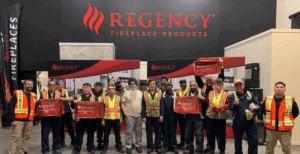
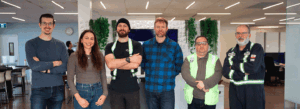
In 2022, Regency Fireplace Products faced significant safety and cultural challenges. High lost time injury rates and incidents, and low morale. Employees said they felt they were expendable, and safety was not a priority. Incidents and injuries were just accepted as part of their workplace culture. “When I joined Regency Fireplace in 2023, it was a company with one of the worst safety records in our classification unit (CU),” says James Rai. “To me, it was inconceivable that two people were getting injured every week and going off work.” With Regency recording 24 to 26 lost time incidents per year, Swedish parent company NIBE insisted they needed to see a change. NIBE expects all their companies to reach high levels of environmental, quality, and safety compliance. By July 2024, this employer of 300 had achieved COR/OSSE certification and reduced lost time incidents to fewer than 6 per year. Changing culture takes leadership commitment By the end of 2023, Rai had a new leadership team in place, with a mandate of improving safety performance. Starting with a three-year strategic plan that addressed the challenges of changing workplace culture, accountability to workers, and injury rates, these senior leaders worked hard to insert safety into the fabric of the company. “Leadership was fighting for safety,” explains Rai, “where before maybe leadership was fighting for production over all.” The leadership team was committed to building a “Safety First” culture. Through leadership coaching and training, regular plant safety walks, and participating in toolbox talks, they influenced directors, managers, and supervisors to also prioritize safety. And slowly the culture of the company changed. Today, employees see safety as a real priority and not just a slogan. “We have long tenured people working here—35 plus years. And for them to change in such a short amount of time, I’m impressed.” James Rai, James Rai, Health, Safety, and Environment (HSE) Manager, Regency Fireplace Products How they started The COR/OSSE certification framework showed Rai where to begin. It helped determine which people needed what training, introduced a methodology to verify safety knowledge, and introduced a process to get everyone trained. “The actual implementation is most of the work,” shares Rai. “You can have a manual on the shelf and that might meet your COR/OSSE certification, but it doesn’t really help you with safety.” Over time, as safety awareness and understanding grew among the workers, as leadership steadily included safety goals into production discussions, the ethos at Regency Fireplace Products shifted, with safety now embedded into the culture. Some Regency employees celebrated their 15th year work anniversary this past year, and others their 35th and 40th. “For them to change in such a short amount of time, I’m impressed,” says Rai of the workers, noting that the team has embraced change and trusted the journey towards building a safer workplace for all. In 2025, Regency Fireplace Products received the Topaz and Sapphire Pinnacle Awards for their continual commitment to safety.
Read More »

A Culture of Prevention: Leading the Way to COR/OSSE Certification

In 2015, when Breanne O’Neil joined the industrial slurry pump manufacturer as a talent acquisition manager, she saw an organization that cared, yet still operated with an “it’s how we’ve always done it” mindset. “Safety… always mattered,” she says. “We didn’t really have a lot of big problems, but it was a lot more procedural than cultural.” Sparking change Over the years, as the company’s products grew larger and more complex, Hevvy/Toyo Pumps sometimes needed outside support to safely complete high-power testing. During one of those tests, an arc flash occurred. Luckily, no one was injured but the potential outcome was clear: relying on luck was not a safety strategy. For CEO Justin Van de Velde, the incident landed heavily. O’Neil remembers him “white as a ghost,” thinking through the worst-case scenario and the unthinkable call to a worker’s loved ones. From that point forward, leadership committed to building a culture of prevention—one where safety sits alongside the other big goals of the organization. Remembering a conversation from a few years earlier, Van de Velde took a closer look at pursuing COR certification—and certification in the Occupational Safety Standard of Excellence (OSSE)­—before announcing that O’Neil would lead the company along their certification journey. Roughly 10 months later, at the height of the pandemic, Hevvy/Toyo Pumps completed its first external audit and achieved certification with a score of 99 percent. “Leadership built a culture of prevention at Hevvy/Toyo Pumps North America—one where hazards are identified early, near misses are reported, and systems improved before an injury could occur.” The importance of visible sustained leadership What made the difference in Hevvy/Toyo’s approach to safety was more than a binder of policies—it was visible, sustained leadership support. Throughout the entire COR/OSSE certification process, executives were part of and helped lead the process. The company reinforced that reporting is welcome and non-punitive, offering multiple ways to speak up: an open-door approach, email, and even anonymous reporting via QR code. Safety expectations were embedded into hiring and onboarding, and the organization invested in consistent and ongoing training to keep knowledge current and prevent complacency. For Hevvy/Toyo Pumps, OSSE certification is proof of something deeper: a company-wide commitment to ensure every employee can raise a concern, learn from near misses, and go home safe. — In 2025, Hevvy/Toyo Pumps was presented a Ruby Pinnacle Award for their ability to maintain their COR/OSSE certification through annual maintenance audits, continued leadership commitment to professional development and continuous learning at all levels, reducing their Injury Rate below their average Classification Unit (CU) over a 3 year period, and improving their experience rating by 10% over a period of 3 years after certification.

Read More »

Certification is Only the Beginning

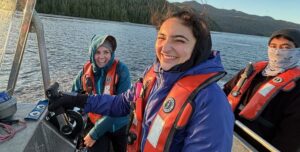
On the Path to Continuous Improvement Tofino-based Creative Salmon raises organic, indigenous Chinook salmon in the waters of Clayoquot Sound. Their team first heard of the value of COR certification through an industry association meeting. To keep up with other fisheries in the region who were pursuing certification, Creative Salmon started looking into what they would need to do to certify their own programs. Mapping the Way Forward Struggling with where to begin, Creative Salmon health and safety manager Ken Roberts described the feeling as being lost in a city without a map. He describes the Manufacturing Safety Alliance of BC in a tongue-in-cheek way as “the gas station attendant” that helped them find their way. Initially overwhelmed by the gap analysis and audit tools, the support of the Alliance team helped them map their path to certification against the Occupational Safety Standard of Excellence. As they progressed, they began to see the value of the new OHS tools they were implementing—and to track the positive changes in their business, both before and after ultimately earning the certification in 2023. “As one of the smaller companies in the salmon farming sector, we thought it would be harder,” Roberts notes. “But after talking to larger companies, we realized it actually was easier for us to implement many of the programs and practices.” Reaping the Benefits Through the process, Creative Salmon recognized that safety is more than a job that someone in maintenance, operations, or HR can do off the side of their desk. Along the way, the company hired a full-time health and safety manager to provide ongoing support for injury prevention and build a more secure and committed workforce. For this company, one of the most significant benefits of achieving the OSSE certification has been in integrating safety procedures and practices into their everyday work culture—making it an essential part of the way they work. Creative Salmon took the opportunity to restructure existing safety programs and build new ones to shore up the gaps. The process has changed their culture for the better, helping ensure that workers at all levels are motivated to keep each other safe. “In addition to the financial benefits, we saw a downward trend in injuries and upward trend in employee retention… But the biggest benefit is that our employees saw the company caring about them, which is exactly what it should be.” Ken Roberts, Health and Safety Manager, Creative Salmon

Read More »

Making the case for safety: Safety programs lead to cost savings​

Three years ago, when Laura Spiers was first hired as the safety specialist for West Coast Reduction Limited (WCRL), the company had already made the decision to pursue COR certification to the Occupational Safety Standard of Excellence (OSSE). In addition to helping build up the company’s safety management system, Spiers was tasked to make a strong business case for safety—and to gain the buy-in of both the company’s leadership and the workforce. “No matter how much effort I put into making the safety program the best it can be, ultimately that meant nothing if the workers or management weren’t involved,” explains Spiers, highlighting how the success of any occupational health and safety program relies on everyone. Getting Buy-in To get buy-in from workers, Spiers involved them through the whole process, engaging with them regularly to hear their input and concerns. “I was able to get buy-in from them because they were literally helping me develop it,” explains Spiers. WCRL’s Nanaimo and Vancouver facilities are very similar—with many of the same duties, equipment, and hazards—just on different scales. “Getting certified together just made a lot of sense,” says James Nygren, chief engineer for the Nanaimo facility. Nygren explains that by working together, they avoided having to reinvent the wheel. By using many of the program pieces developed in Vancouver for Nanaimo, he says, “close collaboration made the whole process a lot easier.” For management, cost savings is an important driver for investing in workplace safety. “In some companies, there can be a disconnect between safety and management,” says Nygren of workplaces in general. “Using tools [like the safety data and trends on WorkSafeBC’s Employer Portal] to quantify what we’ve experienced provides concrete numbers that showed our return of investment.” Immediate Cost Savings When Spiers began to review their safety data—injury rates, WorkSafeBC premiums, costs of equipment, and lost-time—the business case for management was obvious. The company could save of tens of thousands of dollars by reducing the number of injuries, reducing time lost due to injuries, and improving the company’s WorkSafeBC experience rating. Through their work towards OSSE/COR certification, they were able to see immediate results and “pure cost savings.” Over the past three years, WCRL went from paying a surcharge on their WorkSafeBC premiums to getting a discount. “No matter how much effort I put into making the safety program the best it can be, ultimately that meant nothing if the workers or management weren’t involved.” Laura Spiers Tweet “From the safety aspect and my workers’ aspect, they’re safer.” Spiers explained that by going through the process to get certified for OSSE/COR, WCRL made changes to their programs and systems, making the workplace safer for everyone. In 2024, West Coast Reduction Limited earned OSSE/COR certification for both their Vancouver and Nanaimo facilities. “We are not perfect by any means, and I have some huge goals for us in safety in the future,” says Spiers. “But if I stop and take a look back at where we were, we’ve come so far in a few years.” West Coast Reduction receives their OSSE certification. L-R: Colin Campbell (Acera), Wayne Arondus (MSABC), Braden Smit (West Coast Reduction), Laura Spiers (West Coast Reduction) West Coast Reduction Limited is Western Canada’s largest independent rendering company. Every year, they recycle and process around 1 billion pounds of raw material transforming it into ingredients for animal feed, renewable energy, and other products. Family owned and operated; this Vancouver-based company that started over 50 years ago as a single butcher shop, now operates in Saskatoon, Edmonton, Calgary, Lethbridge, Vancouver, and Nanaimo.

Read More »

Safety is a marathon, not a sprint

Fine Choice Foods started 38 years ago as a small family-owned business. Today, they have two facilities and output multiple hundreds of pieces every minute. As a smaller business, change was easier. “To achieve OSSE certification, we knew it could be a challenge to get people to buy in. Just because we have been doing something one way doesn’t mean that it is the right way—or the safest,” said Jason Longden, CEO of Fine Choice Foods Ltd. Leadership is a critical factor. “When I was hired in 2021,” comments OHS Manager Cherri Singleton, “one of my main goals was to see this organization through OSSE certification. I’ve been preparing for it since I arrived.” Through a pandemic, turnover, new hires—young workers and foreign workers—the key to their ability to sustain and build buy-in is trust. A new worker herself, Cherri knew it was important to be visible in the plant and follow through. “When people came to me with ideas or issues, I made sure that we fixed them.” She also made a point to communicate back with the suggesters. Getting buy-in means communicating why safety is the number one priority. It takes patience more than processes, Jason notes, to help workers understand why safety is important. Building relationships takes time, and Jason shares “Safety is a marathon, not a sprint.” By taking the time to do it well, Fine Choice Foods built a healthy and robust safety culture. “Once people realize that you’re there to make things better and easier for the employees, you’ll win,” says Cherri. “People seem much happier, more engaged. There is often a line-up outside my door because people want to talk to us about safety,” Cherri explains. “It may be something very simple, or more major—anything to do with safety. They know they can come to our office with their concerns.” Three years ago, they had to appoint workers to the Joint Health and Safety Committee, Jason notes, today, workers campaign for the honour. “Our people are engaged and want to be part of the solution.” For others considering OSSE, Jason and Cherri emphasized the importance of support and buy-in— from workers and leaders—and of a person to lead the journey. “People like Cherri and our operations group really drove this process, helping us make it a significant business priority.” Jason cautions not to underestimate the path. “It’s work, it’s perseverance, it’s a lot of push,” he explains. “But also, don’t underestimate the joy that you’ll get at the end of it through engagement, better safety, and overall better business. A safe business is a good business, right?” “OSSE is not about a manual or a policy or a procedure or a financial rebate. It’s about doing what‘s right, living a guiding principle to make our business safer for our people.” Jason Longden, CEO, Fine Choice Foods

Read More »

Safety is a priority for us all

For Health & Safety Specialist Dan Oxton and the team at Kicking Horse Coffee, 2023 was a year of accolades and recognition for their safety culture. In June, Kicking Horse Coffee won the Joint Health and Safety Committee Excellence Award at the Safety Pinnacle Awards Gala. In October, they received the 2023 BC Food and Beverage Outstanding Workplace Award and Kicking Horse was recognized as one of the top 10 Greatest Places to Work in Canada™. At Kicking Horse Coffee, physical and mental wellbeing are of equal importance. Through a Joint Health and Safety Committee co-chaired by a People and Culture team representative, the company addresses everything from mental health to heat in the facility during hot summer days to everyday safe work practices. “We’re lucky enough to have a dedicated Joint Occupational Health and Safety team and individuals focused on safety. Where everybody comes to work every day and wants to do what’s right and give their input on how to do things better and improve on what we’re doing,” said Dan during the 2023 Pinnacle Awards Gala. Kicking Horse Coffee encourages everyone to participate in safety, and their leaders and team members have made safety a priority for all. Workers at Kicking Horse Coffee feel safe to bring up concerns and know that those concerns will be addressed immediately. There is an expectation of “you see it, you own it,” and the company considers near misses to be golden opportunities for learning: a way to understand what they can do better and to ensure that they are always finding ways to make their workplace safer. In the recent Great Places to Work Survey, 96 percent of employees said that Kicking Horse Coffee is a great place to work, and their CEO shared the insight that when people thrive, culture and community thrives—and in turn, your business.

Read More »
WHMIS EducationThe Workplace Hazardous Materials Information System (WHMIS) education course provides essential training on the safe handling, storage, and disposal of hazardous materials in the workplace. Available in 5 languages: English, Spanish, Punjabi, Mandarin, and Cantonese.
Navigating BC OHS LegislationAs new or experienced safety committee members, managers, or supervisors, it is important to fully understand and know which OHS regulations are related to your work and how you may be in compliance—or not. This 45-minute self-paced course helps introduce people to information on how to identify and find the OHS legislation related their work—perfect for anyone working at a manufacturing or food processing facility who may be tasked with consulting OHS legislation.
Mental Health Skill Building for WorkersIn this 45-minute, self-paced online course, workers learn to identify common signs and symptoms of mental health issues, to recognize stigma and reduce the impact. They learn practical strategies to respond to a co-worker experiencing a mental health issue.
Managing Difficult ConversationsWhether you're working in an environment in-person or virtually, gain practical tools to help you manage difficult conversations effectively to achieve the best possible outcomes through this course.
Hearing ConservationThis awareness level course will introduce learners to the importance of hearing conservation and how to protect themselves from hearing impairment.
Disability Awareness: Working with People with DisabilitiesCreating an inclusive working environment and workplace is essential for fostering innovation, improving team dynamics, and addressing the evolving needs of today’s workforce. By understanding the challenges faced by people with disabilities and recognizing their unique contributions, learners will gain the skills to support a more diverse and equitable environment. This online course was developed to raise awareness and provide practical strategies to work effectively with people with disabilities.     
Developing a Safety Procedures ManualConsistent safety procedures foster safer working environments, reduce injury-related downtime, and boost productivity. This course will provide participants with the foundation needed to start writing safety procedures that are clear, concise, and practical for day-to-day use. 
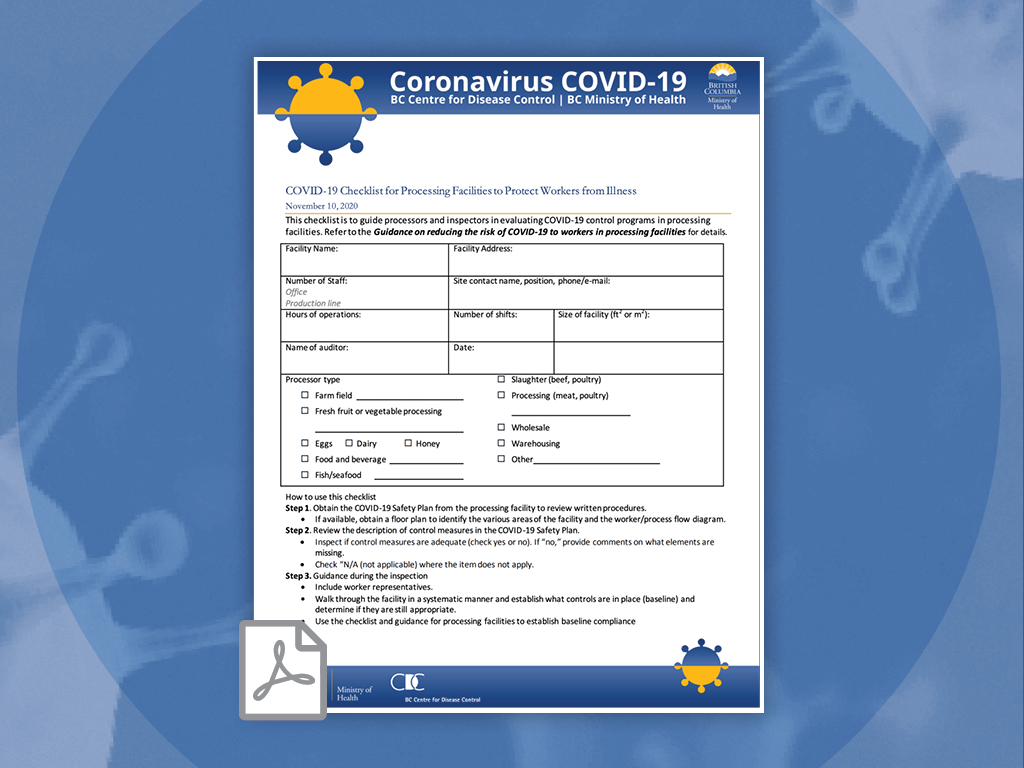
BCCDC COVID-19 Checklist for Processing FacilitiesThis checklist is to guide processors and inspectors in evaluating COVID-19 control programs in processing facilities. Refer to the Guidance on reducing the risk of COVID-19 to workers in processing facilities for details.
Vehicle Emergency Kit Checklist | Road Safety At WorkVehicles and drivers need to be prepared to deal with emergencies. A vehicle emergency kit with the supplies, tools, clothing and other contents that match the weather and driving conditions that vehicle will encounter is a great way to be prepared.
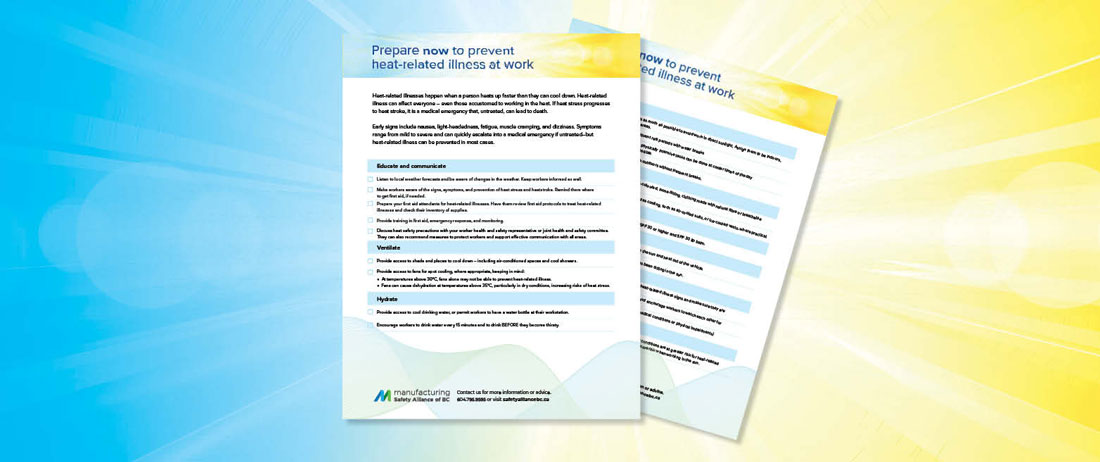
Prepare now to prevent heat-related illness at workHeat-related illnesses happen when a person heats up faster than they can cool down. Heat-related illness can affect everyone – even those accustomed to working in the heat. If heat stress progresses to heat stroke, it is a medical emergency that, untreated, can lead to death.