Leadership

CEO of The Year Award 2026

Canada’s Safest Employers Awards Names Wayne Arondus CEO of the Year

At the 2026 Canada’s Safest Employer Awards in Toronto, Manufacturing Safety Alliance of BC CEO Wayne Arondus was honoured as CEO of the year for his dedication leadership and commitment to the vision of safer workplaces across British Columbia and beyond. “Shocked, but truly honoured. It’s fantastic,” Arondus said, in an interview with Canadian Occupational Safety, “crediting a three-year push by his team to ‘make BC the safest place to live, work, and play.’ “We support all the food and beverage manufacturers in the province of BC, and it was crazy, but we just stayed focused on helping industry,” Arondus said. “This is a nice capstone to that work we’ve done.” The Workplace Safety and Prevention Services Award for CEO of the Year recognizes a CEO who drives successful safety strategies from the top by putting people first and championing innovative safety values. The Manufacturing Safety Alliance of BC is a not-for-profit that supports more than 3,000 member manufacturing and food processing businesses across B.C. The Alliance supports manufacturers with safety guidance, training, and specialized support. “Our manufacturing sector is facing headwinds,” Arondus says. “We are here to help them protect the health and safety of their people even in the most challenging environments,” he explains. “I’m incredibly proud of the work we’re doing together,” he adds, “That we’re seeing more companies come to us for help, and coming back again, is a sign that our support is making an impact.” Under Arondus’ leadership, the organization’s Make It Safe event and webinar series has expanded to educate and connect thousands in Vancouver Island, the Okanagan, northern B.C., the south coast—and outside the province via industry partnerships and the country’s largest virtual safety conference, Make It Safe Canada: Online. After a long career in senior manufacturing leadership role, giving back is a consistent tenet for Arondus—helping bridge the gap between what schools teach and what industry needs as an instructor at BCIT’s School of Business for 20 years, serving as Vice Chair on the Advisory Board for the BC & Yukon Chapter of Make-A-Wish-Canada, and as a past president of the CMHA, Vancouver-Fraser Board of Directors. Arondus is an alumnus of the 8th Governor General’s Leadership Conference of Canada.The finalist list for the 2026 CEO of the Year was deep, with 12 finalist awardees considered for the award: Derek Kelleher – Flanagan Foodservice Don Cooper – Innovator Industrial Services Jon DiMascio – QM LP Ken Robuck – EnergySolutions Canada Marc Breault – Paradox Access Solutions Matthew Bryan – SLB Canada Ltd. Mercy Lawluvi – Immigrant Women Services Ottawa Neil Waugh – NPL Canada Tim Hollander – Toyota Motor Manufacturing Canada Inc Wayne Arondus – Manufacturing Safety Alliance of BC Yves Tremblay – Pronghorn Controls

Read More »

Safety Leadership: Investing in safety

The case for continual workplace improvement At 19, I worked in a grain elevator in southern British Columbia. It was one of my first jobs, and keen to make a good impression, I took the tasks seriously. As a young worker, I was hesitant to ask questions. One day, my manager called me over, along with another young worker, and handed each of us a snow shovel and a paper dust mask. “Go to the basement and fill the grain leg with the mounds of grain, until the room is cleared,” he said, and off we went. I look back today and think about all the things that could have gone wrong. It was like working on a skating rink. We had only one radio, and the dust hazard was very high, with the potential for a multitude of injuries. Today, we work to improve workplace safety through education. We have learned more and know more. Since then, our understanding of workplace hazards has advanced significantly. Technology has advanced, and more safety regulations are in place. However, as I speak with our manufacturing members, many of those same hazards still exist, and changes to operations and machinery have introduced new risks. Safety is about staying curious In 2012, two dust-fuelled explosions hit sawmills in British Columbia’s northern Interior months apart. The community was shocked, the sawmill industry changed overnight, and WorkSafeBC rushed to investigate. What’s one thing those businesses could have done differently? By asking questions and talking to employees about the conditions and environments in which they worked, those companies might have been able to adapt and implement new housekeeping standards to reduce the risk. Our employees, the ones doing the work day-to-day, are often the first to notice when things are wrong. Workers should be the first to challenge us on established practices and existing processes, especially when they no longer serve the goals and intentions within a workplace. A new regulatory environment with the same challenges British Columbia is approaching new dust hazard regulations that will take effect in January 2027. Will these help make workplaces safer? Absolutely. But for owners and leaders of manufacturing facilities, their duty is to streamline production while protecting their teams. Meeting regulatory requirements is only the start. Many businesses maintain compliance. They have fulfilled their legal duty to protect their employees. However, as the world evolves around us, with new technological advances, changing expectations and shifting working conditions, the bar is rising. Equipment that was state-of-the-art 30 to 50 years ago may now be on the verge of retirement. Regulatory compliance does not always reflect changes that impact the work environment. It’s therefore critical to invest in learning. This may mean learning from our successes and failures as we audit our safety management system. We can no longer leave risk assessments and safe work procedures in a binder on the shelf. Through continuous improvement, we need to review and update our systems annually as our businesses change and evolve. Or it may mean learning new models, such as employing a system like 5S to reduce slips, trips and falls. We improve by encouraging the people we lead to ask questions, equipping them to find solutions and adapt, and building a practice of ongoing improvement. “Our employees, the ones doing the work day-to-day, are often the first to notice when things are wrong.” Wayne Arondus Building the culture We can learn from one another in the search for effective strategies to address risk. Ongoing workplace safety exists not only by meeting standards but also through continual improvement and the nurturing of a strong culture of safety. It is easy to fall into patterns of doing things the way they have always been done, but the result can be outdated procedures and practices. Instead, we need to build a system to regularly evaluate policies. We should also solicit feedback from frontline workers. Through review and consultation, we identify new solutions, resources and innovations to keep our businesses nimble, responsive and safe. Continuous improvement goes beyond operational improvements. It starts with equipping our teams with the skills and resources to adapt to a world that is changing rapidly around us. As the demographics and cultural landscape of our businesses shift, we need to lead with clear communication and intentional connection with our people to keep everyone safe. Investing in your team The impact of health and safety is significant. Injuries and incidents not only cause work to stop, but when someone is injured on the job, they strain your remaining team’s capacity and incur replacement and retraining costs. International ORP Foundation President Hans-Horst Konkolewsky notes that health and safety is more than a social or moral concern for business. “Bad working conditions cost firms money,” he says. “Health and safety pays; it really is an investment.” Part of that investment may be in professional development, including targeted technical training and future-focused development through conferences such as the CCOHS Forum or Make It Safe Canada Online. Another key investment is time. By getting to know your team authentically and addressing their concerns, you strengthen your culture, your risk awareness and your ability to adapt. By investing in an ongoing review process, you equip your people and your business to pivot, thereby building resilience to manage future challenges. Together, these actions help you take steps beyond regulatory compliance: strengthening awareness and a safety culture by building a sustainable practice of continual improvement. Editor’s Note: This article by Alliance CEO Wayne Arondus was originally published in OHS Canada October 13, 2026.

Read More »

Manufacturing technology: Risk, reward and roadblocks

Now 30 years in the manufacturing sector, I’ve watched the lightning speed of manufacturing technology advancement, and a growing divide as companies have struggled to keep up. Canada’s tech adoption gap In digital and automated technologies, manufacturers have access to undeniable new tools to reduce risk while increasing productivity. However, as of 2022, only two per cent of the industry had adopted robotics in their facilities, according to Statistics Canada’s Survey of Advanced Technology. The impact is clear, with the Bank of Canada noting the country has fallen to the second-least productive country in the G7 as of 2024. Generative AI upside and risk Today, generative AI and large language models are set to transform the industry yet again. Canada’s industrial sector has just begun to explore the potential for AI to streamline work, increasing efficiency and productivity. And while caution is common, most companies have little understanding of the potential new risks AI and cybersecurity threats represent to intellectual property (IP), employee morale, security, and physical safety. Across industries, AI is a due-diligence issue. AI decisions affect confidentiality and IP, operational continuity, and regulatory exposure long before they show up on the shop floor. So, leaders who treat AI as they would any other high-risk operational change have a much better chance of achieving productivity gains without creating new safety and cyber risk. Where do AI tools look for information, and how do they share it? As companies adopt these tools, leaders also must govern how they work. Safety implications: Where AI helps and where it can harm In safety, we need to consider how AI can best support our health and safety programs – and how it might derail them. Training and guidelines help your employees leverage the potential benefit of AI, while using it efficiently and safely. Understanding the risks of AI to intellectual property, cybersecurity, and safety is essential knowledge for every business leader. AI can summarize policies and data in seconds – a helpful aid to busy safety professionals. But it can also fabricate details or cite the wrong sources. For safety-critical work, a qualified human is required to verify every output. Every day, generative AI models are learning, changing, and adapting. And we also need to learn and adapt to refine the results – to transform the AI models we develop with care into efficient and productive tools. Workforce implications: skills and roles When I started in manufacturing, robots were little more than a dream because they were so cost prohibitive for the average manufacturer. Today, companies are deploying used and new robots and cobots at much more affordable prices to automate operations. And with developments in 3D printing, manufacturers can now take ideas and concepts to working models and designs at a rapid pace. Automation is eliminating tedious, repetitive, and dangerous tasks, moving workers into roles that require more examination, thinking, and intuition. Ultimately, automation is helping to shape safer roles for the humans in our production processes. As automation and AI are helping to engineer out many manual labour and repetitive administrative tasks, they are also increasing demand for skilled labour. Heavy manufacturers are now looking for candidates with degrees in mechanical and electrical engineering and those with extensive technical skills. Others are upskilling and training employees to use new automated systems and perform routine maintenance as we make this historic shift. This technology adoption is eliminating many unsafe jobs, creating new opportunities for upskilling, and attracting more highly skilled people to the industry. At the same time, it is introducing new areas of risk. To safeguard people and brand reputation, we are learning to look for risk in the intersection of people and robotics. We must consider new hazards in automated systems and the ever-growing risk associated with cybersecurity. And we need to address the very real risk of over-reliance on artificial intelligence that does not recognize the gaps in its own knowledge. In the safety community, AI literacy and knowledge of automated systems is quickly becoming part of the essential skillset. Many of the same risks exist for practitioners: recognizing hazards in rapidly changing production environments; leveraging technology to keep people safe, while protecting these same people from technology errors; building critical thinking skills to leverage generative AI with healthy skepticism. Next steps for leaders The safest and most effective path forward begins with preparation. Define appropriate use cases for AI and, perhaps more notably, where its use is prohibited. Creating an AI usage policy is a critical step to protect the integrity of your IP. Set clear expectations to require human validation for every safety-critical output. Update risk assessments as you implement new technologies. Document your cyber controls and, above all, train your people in AI literacy, confidentiality, and verifying AI-generated content. The opportunity is huge. But proceed with eyes open, treating your implementation of AI as you roll out any new operational technology with a plan, effective controls, metrics, and a long-term plan for continuous improvement.   — Editor’s Note: This article by Alliance CEO Wayne Arondus was originally published in OHS Canada July 17, 2026. If you are interested in learning more about AI, technology, and safety, join us this October at Make It Safe Vancouver and Make It Safe Canada: Online. With guest speakers joining us from around the world sharing their insights and expertise into how to best harness new technologies for workplace safety and business success, there are a number of sessions tackling this topic from different perspectives. Check out the program for more details.


Read More »

Leading with Courage: Moving Past Fear

Leaders, by title or by nature, identify concerns, find solutions, and lead the way to success. They are often early to adopt new ideas, to try new strategies, and get to the heart of problem. The best ones lead with purpose and imagination, clearly articulating and rallying others around a shared vision. But leadership can be daunting. One of the things that can holds us back as leaders is fear. Fear of the unknown, fear of being wrong, fear of hurting someone, or more. To me, fear is an acronym. False Evidence Appearing Real. Ninety-plus percent of the things we fear never come to fruition. Yet fear is the thing that can hold us back. To lead successfully, it’s critical to stay motivated and to keeping moving past your trepidation—to take risks. As we all know, successful salespeople understand this well. For every 10 people you call, some won’t respond, some will say, “No,” and maybe one or two will say, “Yes.” Similarly, when you look at the workforce, 97 percent of the population will be completely fine with what they do in their job and the roles they have, and that’s the way it is. Two percent are managers, people leaders, and directors. And that final one percent? They are the CEOs, the business owners, the thought leaders, and billionaires. They are more willing to take risks and step out of their comfort zone. Their willingness to confront their fear and not let it hold them back is much more developed than the rest of the population. That doesn’t make them great, but it does put them in a category of being more persistent. It’s the same in safety. If you’re having success as a safety leader, it’s because you are doing your homework. You are stepping out of your comfort zone to highlight what’s not working. To recommend changes to make your workplaces safer. Where you see risk, you may be more inclined to challenge the way things have always been done for years, even if there’s never been an incident, not yet. And by doing so, you are doing the work to make your workplace safer for all. Let’s not let the lack of an incident lull us into complacency. Let’s not let our own hesitancy be the factor that allows the risk of injury stand. Let’s not let luck be the driver of who gets to go home safely. Remember, the risks we take as safety leaders pale in comparison to the risks our teams take every day in unsafe working conditions, whether they know it or not. — Written by Wayne Arondus | CEO Wayne joined the Manufacturing Safety Alliance of BC in 2019, bringing his passion and commitment of manufacturing excellence to help build strong connections with the 3,000+ member manufacturers supported by MSABC. As Chief Executive Officer, his focus remains member value centric: ensuring members receive quality health and safety guidance, direct onsite support, educational training, and industry expert consultation.  

Read More »

Inside a cyber incident: What really happens and how to respond

Cyberattacks aren’t a distant threat – they’re happening every day to businesses of all sizes. But they don’t have to be catastrophic. With a clear plan and swift action, you can minimize the impact and emerge even stronger. Associate Member Acera Insurance shares some practical strategies to help our members prepare, respond effectively, and build resilience for the future. Learn about the lifecycle of an attack – beginning at the first point of entry to the financial and legal fallout – and actionable strategies for recovery and long-term resilience. From understanding who’s behind today’s attacks to building a tested incident response plan, here’s what you need to know. Who’s driving today’s cyber threats? Cybercrime is no longer just the domain of lone hackers in basements. Today’s threat actors are highly organized, well-funded and increasingly strategic in their approach. Understanding who they are and what motivates them is essential for building effective defences. Here are the top and emerging players shaping the modern threat landscape: Nation-states State-sponsored groups focused on espionage, infrastructure disruption and cybercrime to fund regimes. Organized crime syndicates Criminal enterprises that operate like businesses and are often behind ransomware, financial fraud and large-scale data theft. Lone hackers Independent actors using dark web tools for opportunistic attacks. Hacktivists Ideologically motivated attackers targeting organizations to advance political, social or environmental causes. Where are the weak spots? Attackers rarely storm the gates – they slip through cracks in everyday systems and processes. These vulnerabilities are not only common but increasingly sophisticated, making them prime targets for exploitation. Here are the most frequent and emerging entry points organizations need to watch: Phishing attacks Still the leading tactic for stealing login credentials, spear phishing emails and fake login portals are commonly used together. Cloud vulnerabilities Data has increasingly shifted to the cloud, with many small businesses relying on Microsoft 365 and Google Workspace. Cloud environments face 30 times more attacks than on-premise systems. Brute force attacks Password guessing remains effective where multi-factor authentication (MFA) isn’t enabled – a persistent gap that can be easily addressed. Adversary-in-the-middle (AiTM) A growing threat: even MFA can be bypassed through login session hijacking. These types of attacks are also often initiated through phishing and fake login portals. Email redirection and payment fraud Attackers manipulate email flows to redirect payments from vendors and exploit internal payment processes to siphon funds. Vulnerable edge devices Firewalls, routers and other network hardware are prime targets if not patched or properly configured. Unprotected endpoints Any device lacking robust monitoring or endpoint protection can serve as an easy entry point. The first 24 hours: Every minute counts When a breach occurs, time is your most valuable asset. The first day sets the tone for recovery and can determine whether the impact is contained or spirals out of control. A clear, tested incident response plan is critical. Here’s what to prioritize immediately: Contain the threat: Stop further spread or access immediately. Preserve evidence: Avoid wiping logs and data that could be vital for investigation. Isolate affected systems: Disconnect compromised devices from the network. Secure backups: Ensure clean copies are protected and accessible. Engage experts early: Technical and legal teams should be looped in as soon as possible. If cyber insurance is available, call your insurer’s hotline even if there’s only a suspicion of a breach so they can activate an incident response team and help clarify your coverage to avoid unexpected out-of-pocket costs. Additionally, key vendors to be engaged post-breach include digital forensics, legal counsel, public relations and notification services. Acting fast but in a planned, practiced way is essential. Building resilience beyond prevention Even the best defences can still be breached. Resilience is what keeps businesses afloat when prevention fails. A robust resilience strategy ensures you can absorb the impact, recover quickly and adapt for the future. Here’s how to make resilience part of your organizational DNA: Maintain and test your incident response plan Your incident response plan isn’t something you write once and forget. It should be a living guide that’s tested regularly (just like fire drills) so everyone knows their role under pressure. Include clear steps for containment, evidence preservation and communication. Keep physical copies accessible In a crisis, digital access may be compromised. Store hard copies of your incident response plan and cyber insurance policy in a secure but accessible location. Educate key players Ensure leadership, IT teams, legal counsel and other staff understand their responsibilities. Training should cover decision-making under pressure, escalation paths and vendor coordination. Update regularly Threats evolve, and so should your plan. Review and update your incident response strategy at least annually or after any major organizational change or cyber event. Prepare for business interruption scenarios Think beyond technical recovery. If systems go offline (e.g., VPN downtime for remote workers), how will you notify employees? How will you maintain operations? Build contingency plans for communication and continuity. Resilience = Preparation + Detection + Response + Recovery + Adaptation The cost of a breach Cyberattacks carry a price tag that goes far beyond ransom payments. The financial, operational and reputational consequences can be severe and long-lasting. Here’s what organizations need to consider: Direct financial costs Fees for third-party response vendors including forensic investigators, legal counsel, crisis communications and IT recovery teams. Ransom payments and fees for negotiation services. Fines and penalties from regulatory bodies for violations of privacy law. Litigation costs if legal action is taken by affected parties. Indirect and operational disruption Business interruption (downtime that affects productivity and revenue). Recovery costs (resources needed to restore systems and operations). System fortification (post-breach upgrades to improve security). Human impact Poor communication and uncertainty can damage employee morale and lead to turnover. Strategic and competitive impact Innovation may stall as resources get diverted to crisis management and recovery. A breach can disrupt critical workflows and pipelines, delaying service delivery and project milestones. Third-party consequences Partners may cut off access to their systems and networks until reassurances are provided, and may require audits or impose new standards before

Read More »

Will safety become a victim of the trade war?

When we hear daily news about new tariff threats and trade posturing, our health and safety programs aren’t the first things that come to mind. As tariffs and retaliatory measures continue, we are faced with many choices—where to shop, what to buy, how to support Canadian producers, and more. And at work, we face difficult decisions as we prepare for the business impacts. But in our business decisions, often overlooked are the potential risks and impacts of our actions on the safety and psychological wellbeing of our teams. Some manufacturers and processors are already anticipating the possibility of slowdowns, layoffs, and even potential plant closures. And as these companies brace for an economic downturn, these shifts within the manufacturing environment will echo through the halls of manufacturing facilities and into the minds of workers. It’s natural for workers to worry for their jobs, their finances, and how they will be able to keep their families afloat. The water cooler talk will be about what they think the impacts will be, who might lose their jobs, which departments might see cuts. Whether you are a worker, supervisor, manager, or business leader, there is no way for any of us switch off these worries and pretend that these things don’t matter. For some, these worries can spiral into crippling anxiety. For others, the distraction could cause a momentary lapse of attention or judgement that in the best-case scenario is a near miss, and in the worst could lead to a catastrophic injury or fatality. Transparency and communication As parents, we often think that what our children don’t know won’t hurt them; and many apply this same strategy to their workplace teams. However, pretending that nothing is going to change and not addressing the elephant in the room breeds distrust and can undermine your team’s mental wellbeing and their ability to respond and adapt. Leaders need to recognize that no one likes surprises at work. Proactively addressing worker concerns and doubts can bring down anxiety levels and build trust. Instilling a culture of transparency is not easy, but frank and frequent communication is crucial to ensuring that workers are less distracted and more present. Let your teams know what’s coming next and what major impacts might be on the horizon—even if you aren’t sure what the impacts will be. This transparency will help workers focus better on doing what they do best—while ensuring that you and your team are able to find alternatives and respond to new opportunities that may arise. We need to be mindful as owners, managers, and supervisors of the psychological impact of uncertainty on workers—not only in response to tariffs and a decline in trade, but also any time we face change or when new safety orders are issued. Our workers have been pulled in many different directions over the last five years. Their psychological wellbeing has been profoundly impacted, and their ability to cope may be compromised. By being more present as supervisors, managers, and leaders we show our people compassion and understanding, letting them know that we are there as much as possible. Talk to workers to learn about their concerns. Fix what’s fixable. Solve whatever safety issues you can immediately and demonstrate to your employees through your actions that their opinions matter. By communicating clearly, listening to concerns, and taking action to resolve the things in your control, you can help reduce anxiety and build up your team. Use any and every moment that you can to explain what is currently happening, while reminding your workers of existing supports for stress, depression, and anxiety in your benefits plan, your community, or through your health and safety association. Use crew talks, employee updates, and training to reinforce vigilant health and safety practices. The way through this crisis is together. Focus on your people and build up your team. Make sure your people and your brand’s safety record do not fall victim to economic turmoil, and you will find your team members to be your strongest allies in the crisis and the loudest advocates for your brand in the years to come. By Wayne Arondus, CEO, Manufacturing Safety Alliance of BC Originally published in OHS Canada Magazine, Spring 2025, Digital Edition

Read More »

Leadership Visibility: A Simple but Powerful Mental Health Strategy

Years ago, I worked at a national company headquartered in Vancouver. I didn’t report to the president directly, but I watched him do something simple and powerful: every morning, he’d walk through the office and check in with people, everyone from the custodian to the temp admin to the VPs. He’d remember small details, ask how projects were going (always deferring to managers), and genuinely connect. The Power of Checking In At first, I thought he was checking up on people. In a way, he was, but more importantly, he was making himself visible and approachable. People felt seen, respected, and more likely to speak up early if something was off. That 15–20 minutes a day paid dividends in trust, morale, and performance. A people leader won’t know employees are struggling if they don’t know who their employees are. Small Actions Create Big Impacts  In big organizations, it might not be realistic to know everyone, but it is realistic to know your direct reports and to expect them to know theirs. That chain of connection matters. No one in an organization should feel invisible. Leadership visibility is not optional, it’s a responsibility. People leaders need to go out of their way, even beyond their comfort zones, to walk the floor, check in, and show genuine concern. These small, consistent acts build psychological safety, reduce stress, and strengthen organizational health. Mental health support isn’t just about programs and policies. It starts with people feeling seen and valued, every day. — Editor’s note: Contact Steve to schedule a one-on-one leadership coaching session. Additionally, Steve provides consultations to members on how to create safe and healthy workplaces—and offers workshops on a variety of mental health topics that can impact manufacturing facilities.   Written by Dr. Steve Conway | Director of Leadership and Psychological SafetyOriginally shared via  LinkedIn

Read More »

Respectful Workplace Support

Respectful Workplace Culture: Training and Coaching A respectful workplace culture is vital in promoting employee mental health and well-being, as it fosters an environment where employees feel safe, valued, and supported. Equip your team to respond. Addressing and responding to negative workplace culture, such as bullying, harassment, and workplace violence, is crucial to protecting employees’ mental health. When leaders actively identify and mitigate these harmful behaviors, they create a more positive and productive work environment. This proactive approach not only enhances overall well-being but also boosts morale, engagement, and retention, demonstrating the organization’s commitment to the health and safety of its workforce.Buil Respectful Workplace Workshops and Training A variety of workshops and training programs promote a respectful workplace culture by enhancing employees’ awareness and responsibilities. What support do you need? We can customize training and leadership coaching to meet specific organizational needs—to equip your team with the specific, meaningful education they need to create a welcoming, safe, and inclusive work environment. Review our related training and resources. Or request a call to discuss: Free lunch ‘n learn-format awareness training on multiple mental health and wellness topics—at your facility or virtually Custom training onsite or virtually to support your specific needs on topics such as: Bullying and Harassment in the Workplace. A workshop that addresses the pressing issue of workplace mistreatment, providing participants with a comprehensive understanding of its signs, impacts, and prevention strategies. Attendees will learn how to identify subtle and overt forms of bullying, foster a culture of respect, and implement effective interventions. This workshop empowers individuals to champion a safe and inclusive work environment for all. (1 hr) Workplace Violence: Awareness and Response. An informative one-hour workshop designed for employees at all levels to recognize and address workplace violence. This session covers the basics of identifying potential threats, understanding effective intervention strategies, and implementing preventative measures to maintain a safe and secure work environment. By promoting awareness and proactive response, this workshop aims to protect employee well-being and contribute to a healthier, more supportive workplace. (1hr) Connect and Respect: Transforming Workplace Culture Together. A workshop that provides participants with the necessary tools and strategies to cultivate respectful and collaborative professional relationships. Through real-world scenarios, group discussions, and role-play, attendees will delve into the intricacies of workplace interactions. They will learn how to communicate effectively, provide constructive feedback, and navigate differences with tact and understanding. This engaging session underscores the significance of mutual respect in fostering a cohesive work environment and offers actionable steps to ensure that every team member feels valued and heard. (4 hrs) Schedule a Call FREE for Members Request a call. We will follow-up to schedule a time to answer your questions or discuss your training or coaching needs. Meet the specialist Dr. Steven ConwayDirector of Leadership and Psychological Safety Related Training and Resources Available 24/7eLearningVirtualClassroomBullying and Harassment AwarenessEmployers, supervisors, and workers all have responsibilities under WorkSafeBC OHS Policies to prevent bullying and harassment in the workplace. This Bullying and Harassment Awareness course is meant to offer training to workers on identifying bullying and harassment in the workplace, its impact and practical strategies to prevent it.Enroll Bullying and HarassmentBullying and harassment can create a poisonous work environment that hurts productivity, disrupts work, and decreases morale.

Read More »

Leadership Training and Coaching

Leadership Training and Coaching Management training and coaching for people leaders at all levels: Supervisors and managers Business owners, and executives For leaders in the manufacturing industry and beyond, proactive leadership training and coaching builds a positive work culture and supports sustainable, long-term performance. Leaders have a responsibility to identify and respond to mental health concerns and to address the risk of psychological injury just as they address physical risks in the workplace. And effective leaders foster respectful workplaces where everyone feels safe and supported in their work.  Leadership Support Services Leadership Coaching Coaching support can help business leaders and supervisors develop effective communication skills and emotional intelligence—critical tools for effective leadership. Personalized guidance and feedback helps leaders improve their communication and conflict resolution skills and build empathy. This growth in emotional intelligence helps them better understand and manage their own emotions, as well as those of their team members, creating a more supportive and collaborative work culture.  Employee engagement and retention improve as team members feel more valued and connected to their leaders and to the organization. This holistic approach to leadership coaching not only strengthens individual leaders but also drives overall organizational success.  All coaching is facilitated by Director of Leadership and Psychological Safety Dr. Steven Conway, an International Coaching Federation (ICF) Professional Certified Coach (PCC) with 15 years of coaching experience. Please inquire for rates. Members save 25% on all coaching services. Leadership Consulting Guidance, direction, and resources to address and navigate unique mental health, leadership, and workplace culture issues. This support can help leaders manage change and crisis situations effectively, but does not include personal counselling services Management Training for People Leaders Choose from a range of workshops and training options for people leaders build mental health awareness and essential soft skills. Schedule a Free Consult Request a call. We will follow-up to schedule a time to answer your questions or discuss your training or coaching needs. Meet the specialist Dr. Steven ConwayDirector of Leadership and Psychological Safety We design training sessions to meet specific leadership needs, to give your managers, supervisors, and executive team the most relevant and impactful education for success in their roles. Resources and Training CoursesReview related training and resources (including new eLearning and instructor-led courses for supervisors and workers). Free Awareness Training for MembersRequest a call to discuss free lunch ‘n learn-format awareness training on mental health and wellness topics—at your facility or virtually. Customised Training for Managers and SupervisorsRequest a call to discuss training tailored for your managers and supervisors, onsite or virtually, on topics such as: Leading with Emotional Intelligence: The Link Between EQ and Psychological Safety at Work. Understand the role of Emotional Intelligence (EQ) as a critical leadership ability and explore the critical connection between EQ and fostering a psychologically safe workplace environment. Learn to leverage EQ to promote trust, encourage open communication, and drive team performance. Leadership Accountability for Health and Safety. Clarify the roles of leaders at all levels in workplace health and safety. Ensure that your management team is compliant with safety regulations and understands their legal duties. Learn the role of managers in leading investigations and training and in responding to injuries. Ensure that your leaders recognize the cost of safety failures and their accountability under the law. Related Resources and Training LeadershipThe employer/manager/owner of all businesses in BC – regardless of their size – is responsible for the leadership of the safety and health programs. This includes the effectiveness and improvement of your health and safety program.  It also means, as a leader, you must provide the safeguards to ensure safe conditions for your workers. The responsibilities for health and safety in the workplace are a shared responsibility between own/operators, supervisors/managers, and workers. eLearningVirtualClassroomCore Competencies for People Leaders: Enhancing Interpersonal and Soft SkillsA comprehensive full-day workshop, Core Competencies for People Leaders is designed to equip leaders with critical interpersonal and soft skills. No upcoming sessions? Learn more about our waitlists and private training. More information. eLearningVirtualClassroomMental Health Management for LeadersIn this 6-hour, instructor-led course for leaders, learn to recognize and battle the stigma surrounding mental health. Understand the impact of mental health and mental illness on your team and on your own work—and how to respond to a worker in distress.

Read More »

Leaders Need to Understand Workplace Mental Health

Workplace mental health isn’t just a “nice to have”—it’s a cornerstone of organizational sustainability. When employees feel supported, they’re more engaged, productive, and resilient. But beyond the business case or proven ROI’s, there’s an even more important reason to focus on mental health: it’s simply the right thing to do. Leadership isn’t just about achieving results; it’s about taking care of the people who make those results possible. Most people leaders have never been trained in mental health which can lead to uncertainty and hesitation about what to do to support employees. Some worry about making things worse. This is completely understandable. So how can leaders start? First, it begins with education. People leaders need to access training to understand the basics of mental health and how to recognize when someone might be struggling. Reducing stigma is another essential step. We need to talk about mental health as openly as we do physical health, fostering an environment where conversations are normalized and safe. It’s also about paying attention to your people—really noticing when someone’s behaviour or energy seems off—and responding with empathy when they do open up. Sometimes, the most powerful thing you can do as a leader is to listen, acknowledge their experience, and avoid rushing to solutions. Finally, make sure you have resources available, like Employee and Family Assistance Programs (EAFAP) or access to community mental health services. When employees know there’s help available, it creates a foundation of trust and reassurance. It also provides people leaders with greater confidence that they can be helpful in an appropriate way. When leaders prioritize mental health, they’re not just improving organizational outcomes—they’re creating workplaces where people feel safe, valued and supported. And in the end, that’s what effective leadership is all about. Written by: Dr. Steve Conway | Director of Leadership and Psychological SafetyOriginally shared via LinkedIn

Read More »
Respirator Inspection ChecklistA handy, printable checklist for inspection of your respirators.
Communicable Disease Prevention PlanThis template is a guide to ensure that you have considered the communicable disease prevention measures to prevent the spread of COVID-19, flu, colds, and other viruses in your workplace. Although you are no longer required to maintain a formal, written plan (unless directed by Public Health), by completing this checklist, you can be confident you have all the information you need to communicate measures with staff, contractors, and visitors.
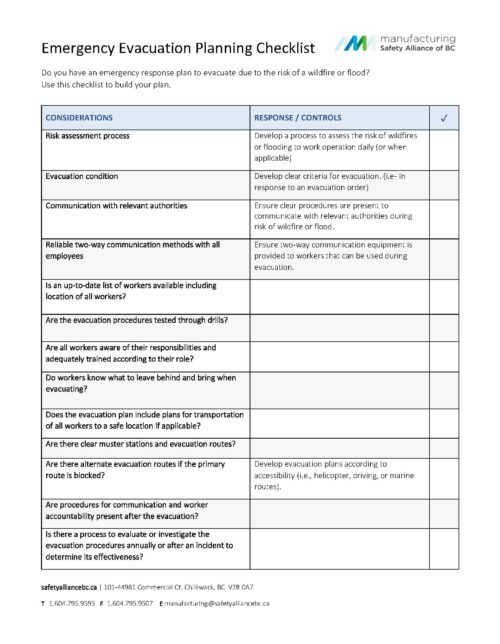
Conducting a Hazard Assessment after a floodBusinesses impacted by a flood must take steps to ensure their personal safety and their employees, including a hazard assessment. Do not enter a flood-damaged location without first reviewing the risks and putting protections from potential hazards in place.
WHMIS EducationThe Workplace Hazardous Materials Information System (WHMIS) education course provides essential training on the safe handling, storage, and disposal of hazardous materials in the workplace. Available in 5 languages: English, Spanish, Punjabi, Mandarin, and Cantonese.
Navigating BC OHS LegislationAs new or experienced safety committee members, managers, or supervisors, it is important to fully understand and know which OHS regulations are related to your work and how you may be in compliance—or not. This 45-minute self-paced course helps introduce people to information on how to identify and find the OHS legislation related their work—perfect for anyone working at a manufacturing or food processing facility who may be tasked with consulting OHS legislation.
Mental Health Skill Building for WorkersIn this 45-minute, self-paced online course, workers learn to identify common signs and symptoms of mental health issues, to recognize stigma and reduce the impact. They learn practical strategies to respond to a co-worker experiencing a mental health issue.
Managing Difficult ConversationsWhether you're working in an environment in-person or virtually, gain practical tools to help you manage difficult conversations effectively to achieve the best possible outcomes through this course.
Hearing ConservationThis awareness level course will introduce learners to the importance of hearing conservation and how to protect themselves from hearing impairment.
Disability Awareness: Working with People with DisabilitiesCreating an inclusive working environment and workplace is essential for fostering innovation, improving team dynamics, and addressing the evolving needs of today’s workforce. By understanding the challenges faced by people with disabilities and recognizing their unique contributions, learners will gain the skills to support a more diverse and equitable environment. This online course was developed to raise awareness and provide practical strategies to work effectively with people with disabilities.