
COVID-19

COVID-19 virus magnified

COVID-19 update from WorkSafeBC

Expedited workplace closures – what employers can expect On April 11, 2021, an order of the provincial health officer (PHO) delegated specific powers to WorkSafeBC prevention officers. The order provides WorkSafeBC prevention officers the ability to serve a 10-day closure order on an employer with COVID-19 transmission when directed so by a medical health officer. WorkSafeBC’s role is well defined and narrow in scope, with no role in deciding which workplaces will be served with a closure order. Questions regarding the closure order itself are referred to the Health Authority Medical Health Officer. When WorkSafeBC prevention officers deliver a closure order to affected workplaces, they will also help the employer understand their need to review their COVID-19 safety plan and make any necessary changes during the closure period. WorkSafeBC will be available to provide guidance around reviewing and updating COVID-19 safety plans. Then, once the workplace has re-opened, WorkSafeBC will conduct an inspection to review the employer’s COVID-19 safety plan and ensure the employer is effectively implementing measures to prevent the transmission of COVID-19 in the workplace. Findings from COVID-19 inspections Throughout the pandemic, WorkSafeBC has been engaging employers to ensure that protocols identified in their COVID-19 safety plan have been effectively reviewed, updated, and implemented, and that exposure to COVID-19 is being effectively managed in the workplace. This includes issuing an inspection report with orders in cases where improvements to COVID-19 safety plans and protocols are required. They recently analyzed 1,600 COVID-19 orders to identify the controls most frequently identified as needing improvement. They include: Physical Distancing Ensure physical distance of 2 metres is maintained between workers and others whenever possible, especially in shared spaces; consider changing the layout of workspaces to enable physical distancing in all work and break areas. Provide physical barriers such as Plexiglas if physical distancing between workers and customers cannot be maintained. Signage Post signage that reminds workers of the controls in place, including occupancy limits, handwashing practices, health-check requirements, and entrance restrictions. Use physical queue controls, such as crowd-control cones or floor markers to regulate traffic and physical distancing. Policies and Protocols Develop and post a COVID-19 safety plan that identifies and addresses the risks in all areas of the workplace. Ensure there are posted policies for employer and visitor daily health screening. Training Ensure health and safety information and training is provided in the required languages so it can be understood by everyone at the workplace. Supervision and Monitoring Communicate safety programs and policies clearly to workers through information-sharing, instruction, training, and supervision to ensure the controls in place are being followed. Facilities Provide adequate hand-washing facilities on site for all workers. Place alcohol-based hand sanitizer at key areas of your workplace (near pay stations, in break rooms, etc.). Personal Protective Equipment Make sure appropriate masks are available and being used properly for the work being carried out. For more information about all aspects of a COVID-19 safety plan, please refer to the following resources: Reviewing and updating your COVID-19 safety plan: A guide for employers COVID-19 safety plan video series: Five steps to developing your COVID-19 safety plan Reporting COVID-19 exposure claims As a reminder, employers and workers should continue to report a workplace injury or disease during this time, including those involving a work-related exposure to COVID-19. Contracting COVID-19 in the workplace may be considered a work-related occupational disease, and affected staff members have the right to make a claim and could be eligible for health care and wage-loss benefits. For information on when and how to report a COVID-19 illness to WorkSafeBC, please visit the Claims COVID-19 pages on worksafebc.com for information for both workers and employers.

Read More »

Provincial Health Officer order delegates specific powers of the Public Health Act to WorkSafeBC prevention officers

Today, the Provincial Health Officer announced new orders delegating specific powers of the Public Health Act to WorkSafeBC prevention officers. Under the new order, WorkSafeBC prevention officers are limited to serving a closure order to a business with a known COVID-19 outbreak. The closure order will be in effect for a period of 10 days, or more, as prescribed by the health authorities Medical Health Officer on a case-by-case basis and when directed to do so by a Provincial Medical Health Officer. WorkSafeBC is providing this support to help the Province manage the recent increase in COVID-19 cases. When serving the closure order, the WorkSafeBC prevention officer will discuss the employer’s COVID-19 safety plan and provide the employer with the “Reviewing and updating your COVID-19 safety plan” resource guide. The prevention officer will advise the employer to review and make improvements to their COVID-19 safety plan. When the workplace reopens, the prevention officer will conduct an inspection to review the employer’s updated COVID-19 safety plan to ensure the employer is effectively implementing measures to prevent the transmission of COVID-19 in the workplace. The increase in COVID-19 cases across BC is an important reminder that we all have a shared responsibility to remain vigilant in supporting workplace health and safety during the pandemic. The Alliance is available to support BC manufacturers and food processors to strengthen their COVID-19 safety plans and keep their workers safe. Call our OHS Support line to get immediate support from a safety advisor – 604.795.9595 or visit safetyalliancebc.ca/covid-19 for resources and tools, webinars and online training, and updated expert answers to frequently asked questions about the virus and recommended workplace controls. Resources: Checklist: Review your COVID-19 Safety Plan Request a call from a safety advisor Provincial Health Officer orders and notices WorkSafeBC COVID-19 website for resources and information on keeping workplaces safe, including information on the PHO order and inspections and consultations during the COVID-19 pandemic

Read More »

New Circuit Breaker Business Relief Grant announced

Minister Ravi Kahlon has announced the new Circuit Breaker Business Relief Grant which will provide $50 million to help the 14,000 restaurants, bars, breweries, wineries, gyms and fitness centres affected by the March 30, 2021, Provincial Health Orders. The new Circuit Breaker Business Relief Grant will provide affected businesses up to $10,000 in one-time funding to help with expenses like rent, insurance, employee wages, maintenance and utilities. The grant can also help cover unexpected costs that resulted from the restrictions, such as the purchase of perishable goods. The individual amount a business receives will be based on the number of employees. The grant is open to eligible businesses of any size that have been in operation since February 1, 2021. Applications are expected to open the week of April 12, 2021, and will close on June 4, 2021, or until the funds are dispersed. We invite you to share this information with your networks and encourage interested businesses to visit www.gov.bc.ca/business-relief to register to receive an email notification when applications open. Read the full news release >

Read More »

COVID-19 vaccine news for BC food processors and manufacturers

Since mid-March, more than 20,000 essential workers at Alliance member companies have received their first immunizations. That initial priority campaign ended in late March. The health regions are waiting for direction from the province to determine whether, when, and how they may be able to resume priority immunization of production workers. We will continue to update you here as we learn more.

Read More »

A pandemic good news story: immunizing BC’s essential manufacturing workers

“This is not a joke.” Wayne Arondus, Chief Operating Officer at the Manufacturing Safety Alliance of BC, started calling members about an opportunity to immunize their staff against COVID-19, but he encountered some skepticism. “Some of the people I talked to thought I was pranking them!” said Wayne. “A couple even called the office to confirm I worked here.” When Vancouver Coastal Health contacted the Alliance looking for support in getting the word out to manufacturers about an opportunity to immunize their staff, we jumped at the chance. “We have been advocating for priority access to the vaccines for front-line, essential workers since the vaccines first arrived in British Columbia,” said Lisa McGuire, CEO and President of the Manufacturing Safety Alliance. “We know there are ongoing challenges to manage COVID-19 outbreaks in food processing and other manufacturing settings. Immunization offers the best protection for workers, businesses, and their families from COVID-19, and seeing this opportunity become available for food processing workers has been really rewarding.” “I wanted to thank you for the support of VCH in vaccinating my team today at the Triumph location. We are very grateful for all your front-line nurses and staff who were courteous, knowledgeable and very upbeat today. We look forward to completing the second vaccine as soon as the schedules permit!” With additional vaccines approved for use in Canada, BC adjusted its Immunization Plan to allocate COVISHIELD/SSI vaccine to protect workers in industries facing obstacles managing COVID-19 risks. In some workplaces, the full use of barriers or personal protective equipment is complex. In many food processing facilities, workers’ proximity makes them more at risk for transmission and COVID-19 outbreaks and clusters. “Excellent news, thank you so much! We will absolutely encourage all staff to take advantage of this opportunity.” COVISHIELD/SII is a viral vector-based vaccine that uses a harmless virus as a delivery system. Two doses of the vaccine allow a person to build a robust immune response without exposure to the COVID-19 virus. Canada has a comprehensive approval process for new vaccines and closely monitors all vaccines for safety, efficacy, and side-effects. COVID-19 immunization provides the best hope for an end to this global pandemic and a return to everyday life. And, while we continue to rely on managing the risk of transmission through tools like barriers, physical distancing, personal protective equipment, and other controls, we are looking forward to a time when we can resume “business as usual.” “The  information from the Manufacturing Safety Alliance of BC and Vancouver Coastal Health has been very clear. The clinic staff were very kind and courteous – all of our staff felt well taken care of, and Vancouver Coastal has been very responsive to my questions. Overall, we at WCRL feel privileged to be permitted to participate in the clinic and we appreciate all of your hard work in getting this initiative up and off the ground!” “We are encouraging everyone eligible to get the vaccine as soon as it is available to them,” said Dr. Michael Schwandt, Medical Health Officer with Vancouver Coastal Health. “Immunity through vaccination helps you fight the virus if you’re exposed and can help protect the people around you.” We are continuing to work with Vancouver Coastal Health to support the ongoing vaccination clinics and have offered our support to the other BC Health Authorities. “Thanks for leading this for manufacturing. We have a lot of happy people in our building here today.” “Ensuring the safety of our critical food-processing workers—and by extension, their families and neighbours—is something we will continue to advocate and work to protect,” promises Lisa McGuire. “Getting the vaccine to as many front-line workers as possible will help control the potential for outbreaks in these critical businesses and surrounding communities.”

Read More »

COVID-19 Safety Plan Review checklist – Help with New BC restrictions

Effective November 7, the Provincial Health Officer issued new restrictions for the Lower Mainland and Fraser Valley. WorkSafeBC followed November 10, sharing plans to ramp up enhanced COVID-19 inspections and consultations with employers: To supplement the inspections, WorkSafeBC is also increasing its ongoing consultations with employers about COVID-19 so they can effectively identify and manage COVID-19 exposure risks in the workplace. And new information and resources are being added to the WorkSafeBC website at worksafebc.com. “Workplace health and safety are essential in protecting workers and keeping businesses open,” says Al Johnson, head of Prevention Services for WorkSafeBC. “Employers need to ensure their COVID-19 plan is effective, that it’s followed to the letter, and that it’s applied to all aspects of the workplace.” Call the Manufacturing Safety Alliance of BC at 1.604.795.9595 for help reviewing your controls: pre-screening protocols, ventilation, and how you can strengthen controls to prevent transmission and keep your doors open.  Review your safety plan with this new checklist: Book a call with an advisor Download the COVID-19 Safety Plan checklist Visit the COVID-19 resource centre Download a sample mandatory mask policy Notables for BC employers: All businesses and worksites must: Conduct active daily in-person screening of all onsite workers using the COVID-19 symptom checklist that is part of every business restart safety plan. Ensure that all workers and customers maintain appropriate physical distance and wear masks when appropriate. Take extra care in small office spaces, break rooms, and kitchens. From November 7, 2020 at 10 pm to November 23, 2020 at 12 pm, limit travel into and out of the Lower Mainland and the Fraser Valley to essential travel only. Despite our best efforts to control transmission, rates are rising as anticipated with the shift into fall and winter. While we recognize the work you have already put into your Safety Plan, it is important to continue to review it as we learn more about the virus and ensure that your staff remains vigilant. Complacency can put our workers at risk and may increase the risk of further lockdowns. Call the Manufacturing Safety Alliance of BC at 1.604.795.9595 for free support and advice. We are on call to help you. Book a call or an online meeting where one of our health and safety advisors can connect with your safety person or committee to look for opportunities to strengthen your COVID-19 Safety Plan. Keep up to date with the latest COVID-19 information: WorkSafe BC: Reviewing and updating your COVID-19 safety plan: A guide for employers. This guide was developed to walk employers through the process of reviewing and updating their COVID-19 Safety Plans, as required by the Nov 7 PHO order to FHA and VCHA employers, and asked of from all employers in the province by Dr. Henry in her press briefings. Updated WSBC COVID-19 Safety Plan Template 2020 Q4 initiative: Maintaining COVID-19 safety plans Controlling Exposure. Information about applying appropriate controls, including considerations in the use of masks. Summary of recent changes to WorkSafeBC’s COVID-19 content Province of BC: Lower Mainland and Fraser Valley restrictions Future updates: Watch our COVID-19 website for the latest information and tools

Read More »

Prioritize and layer controls

Start from the top to implement the most effective controls possible in your facility. Postpone, reorganize, or plan work to eliminate the risk to workers. Physical distancing is essential to control the spread of COVID-19. Most manufacturers and food processors have already added floor markers and directional signs to promote distancing and manage traffic flow. Other common controls include staggering start times, shift, and breaks; restricting occupancy in common areas; and holding meetings outside or through video conference where possible. Where employees cannot stay two metres apart, physical barriers provide critical protection. Use personal protective equipment such as surgical masks, face shields, aStart from the top to implement the most effective controls possible in your facility.nd gloves to supplement more effective controls, or as a last line of defense when physical barriers and distancing are not possible. Depending on a risk assessment in your work environment, appropriate PPE could include face shields, disposable gloves, masks, or coveralls. Daily health checks and limited visitation may also be important safeguards. Because COVID-19 is spread through close contact, the pandemic has increased the need to maintain cleanliness and hand hygiene to reduce the spread. Adequate handwashing stations are critical, along with fresh air where possible and a ventilation system working up to code. “We really need to invest in relationships in our business. Purpose and connection protect against stress.” — Chris Inkster, Freeport Industries, in a June executive panel on Leading the Recovery Smart controls. Smart controls include no-touch trash cans, propped-open doors, disinfectants, and disposable towels to clean workstations. Policies that ensure workers wash their hands thoroughly when entering the workplace, before and after breaks, at shift changes, and after touching a surface others may have touched are also important. Provide individual equipment for each worker—or sanitize any shared equipment when sharing of equipment cannot be avoided. Make sure employees know what you are doing to protect them and what they can do to protect each other. Need help sourcing PPE? Visit safetyalliancebc.ca/ppe

Read More »
Training and Support

COVID-19 training and support

As you have been adapting to new methods and approaches for your business, our focus at the Alliance has been to research, develop, and share the latest knowledge and tools to support BC’s manufacturers and food processors. Call the OHS Support line to get immediate support from a safety advisor. 604.795.9595 Visit safetyalliancebc.ca/covid-19 for resources and tools, webinars and online training, and updated expert answers to frequently asked questions about the virus and recommended workplace controls.   Dust Hazard Analysis | How to Conduct a DHA Analysis that meets the NFPA 652 standard In 2019, the National Fire Protection Association updated its Standard on the Fundamentals of Combustible Dust (NFPA 652), requiring all companies with combustible dust hazards to have completed a dust hazard analysis (DHA) by September 2020. While the NFPA Standard is not currently enforced by provincial regulators, it is considered best practice and in the case of an incident, is typically brought forward in due diligence. Developed by REMBE® and hosted by the Manufacturing Safety Alliance of BC, this two day course, the first of its kind offered in Canada, will teach you how to conduct a Dust Hazard Analysis that meets the NFPA 652 Standard. Seating is limited. Register soon. safetyalliancebc.ca/dusthazard Sensitivity Training Partnership Schoolyard bullies grow up and go to work. Sensitivity Training builds awareness to keep inappropriate behaviours in check and protect your most valuable asset: your employees. So we are pleased to introduce a new partnership with Sensitivity Training Canada, a leading national provider of training and services to make workplaces respectful through workplace wellness and sensitivity training. Through this partnership, Alliance members gain access to 11 new courses as well as anti-bullying and anti-harassment policy and program development services—all at a discounted rate. These Sensitivity Training Canada courses are available as half-day workshops, 2-hour seminars, in person and through virtual training: Cultural Sensitivity Training for Diversity Workplace Anti-Bullying and Anti-Harassment Respect in the Workplace Resilience in the Workplace Anger Management Mental Health Awareness Workplace Anti Sexual Harassment Sensitivity Training for Workplace Restoration Sensitivity Training for Employees Sensitivity Training for Middle Managers Sensitivity Training for Executives Learn more safetyalliancebc.ca/sensitivitytraining

Read More »
cybersecurity

Growing your business online in the “new normal” comes with new risks

As companies adjust their business to address the challenges of the global pandemic, many have expanded their online operations and moved to virtual workspaces for employees. Growing your business online has advantages in the “new normal” but also comes with new risks. “Cyber insurance is relatively new but has roots in privacy liability insurance which has been around for several years,” said Rob Selnes, one of the cyber leaders at CapriCMW. “More and more companies are doing business online, but the threats of doing business this way have changed significantly over the last few years” The technology that businesses use is savvier – but so are the criminals. The risks of cyber attacks are real and the expenses incurred following an attack are generally not covered by commercial general liability insurance. The average cost of a data breach in Canada is now approximately $6 million, and while many of the cyber attacks we hear about happen to major organizations, cybercriminals don’t care how large your business is. The impact of a cyber attack on a small business can be devastating. Approximately 70 percent of cybersecurity incidents are the result of employee error or a lack of IT security training, such as: Phishing attacks Sharing passwords or having weak (or non-existent) passwords Inappropriate use of IT resources Physical loss of devices (such as phones or laptops) Improper data sharing Introducing viruses and malware to company systems The average cost of a data breach in Canada is now $6.11 million. These types of incidents can lead to privacy breaches, data and financial theft, unauthorized access to business systems and ransomware attacks. Many employers don’t appreciate how sophisticated cybercriminals are,” said Selnes. “And the pandemic has presented new opportunities to these criminals. Many companies have also had to suddenly adapt corporate IT systems to accommodate work-from-home options which haven’t generally been thoughtfully planned out.” Companies also have less time to think about cybersecurity issues while dealing with the ongoing challenges of COVID-19. Even those with great IT teams can only do so much and many companies don’t have a dedicated IT team at all. The Cyber Liability and Privacy Liability insurance offered by CapriCMW covers not only the liability side of a cyber attack (theft of information and privacy breaches) – but also picks up legal costs and provable damages. Additionally, these policies cover businesses for the costs associated with loss of service, ransomware, and stolen funds. However, Selnes points out that a key benefit of these policies is their ability to provide the policyholder with immediate access to crisis management and cybersecurity experts. Cyber attacks are usually sudden and highly time-sensitive, so immediate access to dedicated legal, IT security and public relations expertise provides companies with critical support when they need it most. For the cost of this insurance, companies basically have a broad team of specialists available on retainer to keep their business running before, during and after a cyber attack. Success in the “new normal” means working with your insurer to protect your business, data, and clients. For more information about Cyber Liability and Privacy Insurance contact CapriCMW Insurance Services Ltd.

Read More »
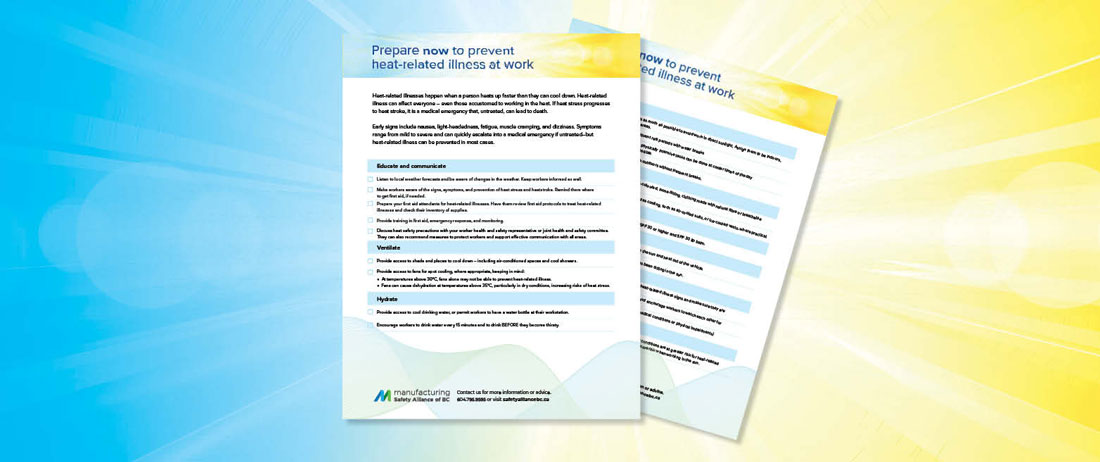
Prepare now to prevent heat-related illness at workHeat-related illnesses happen when a person heats up faster than they can cool down. Heat-related illness can affect everyone – even those accustomed to working in the heat. If heat stress progresses to heat stroke, it is a medical emergency that, untreated, can lead to death.
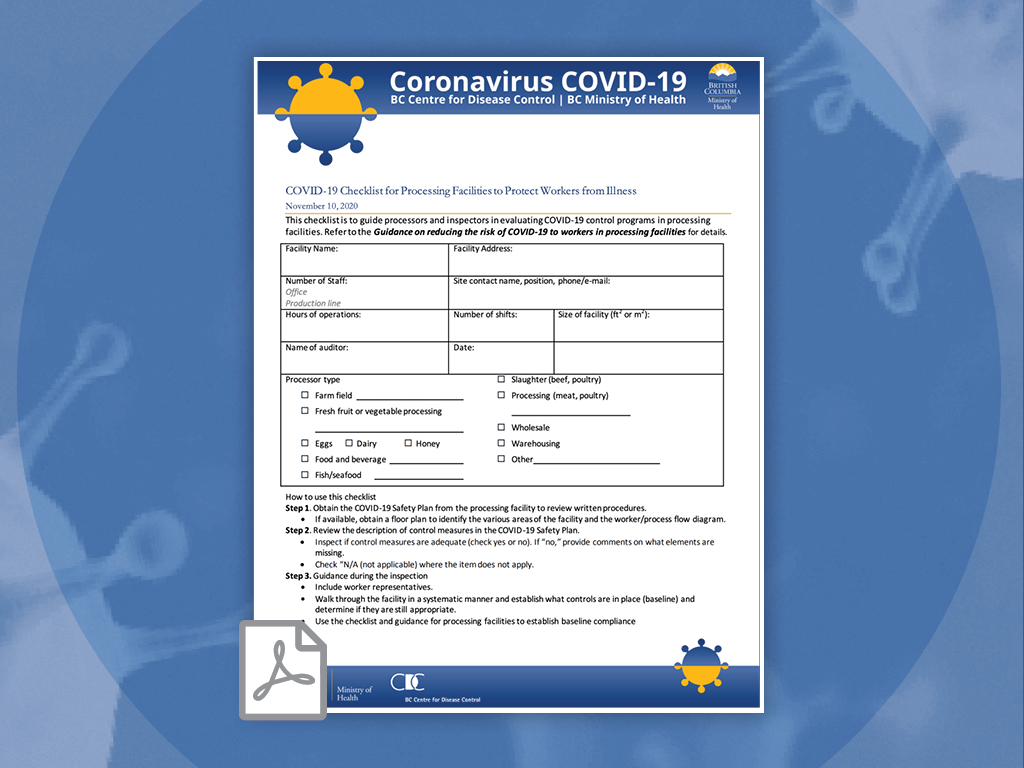
BCCDC COVID-19 Checklist for Processing FacilitiesThis checklist is to guide processors and inspectors in evaluating COVID-19 control programs in processing facilities. Refer to the Guidance on reducing the risk of COVID-19 to workers in processing facilities for details.
Communicable Disease Prevention PlanThis template is a guide to ensure that you have considered the communicable disease prevention measures to prevent the spread of COVID-19, flu, colds, and other viruses in your workplace. Although you are no longer required to maintain a formal, written plan (unless directed by Public Health), by completing this checklist, you can be confident you have all the information you need to communicate measures with staff, contractors, and visitors.
COVID-19 safety planAs our knowledge of the COVID-19 virus grows, we need to review our COVID-19 Safety Plan to ensure that it remains effective and relevant to protect our workplaces and communities. Use this checklist as a guide to help strengthen your plan.
X-ray Inspection ToolkitA collection of checklists to help guide routine x-ray equipment inspections, including a resource for Joint Health and Safety Committees
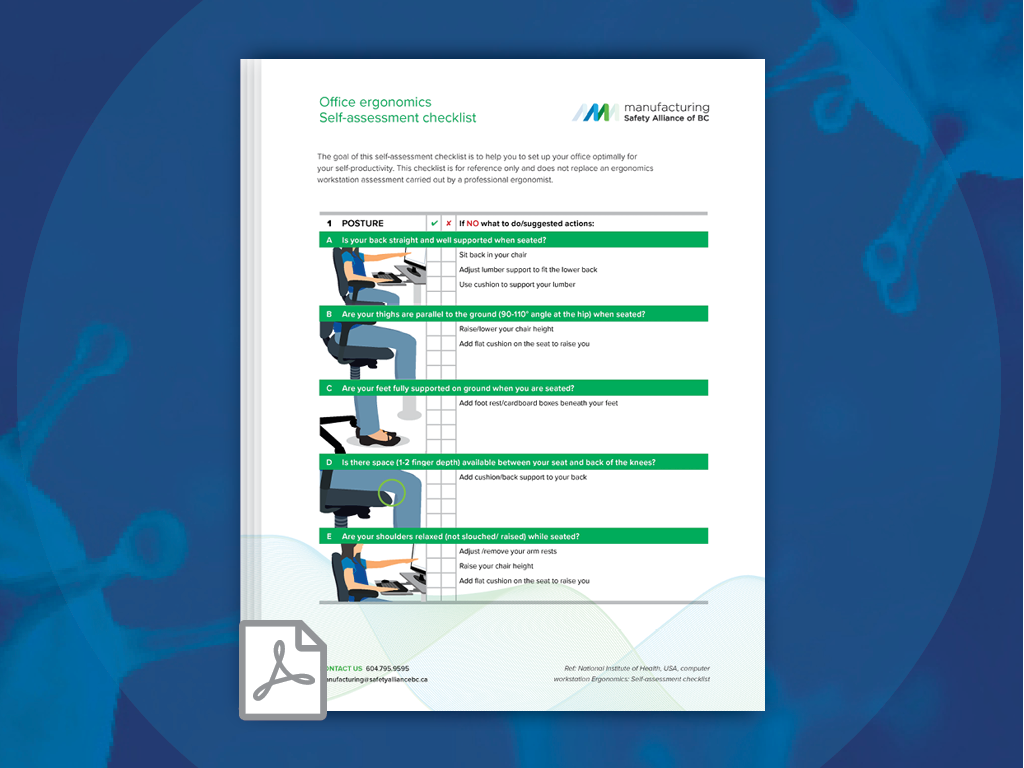
Office ergonomics Self-assessment checklistThe goal of this self-assessment checklist is to help you to set up your office optimally for your self-productivity. This checklist is for reference only and does not replace an ergonomics workstation assessment carried out by a professional ergonomist.
The First 30 Days After an Injury: What Employers Get Right (and Wrong)What happens in the first 30 days after a workplace injury matters. From the first conversation to planning next steps, employers face decisions that touch recovery, worker trust, and day-to-day operations. Join us for a fireside chat with a disability management specialist as we explore what employers get right—and where common missteps can complicate the path forward. Discover practical considerations for communicating clearly, supporting recovery, and balancing operational needs with worker well-being.