Newsletter

Make it Safe Magazine | 2021 Safety Excellence Edition

The digital OHS magazine for manufacturers and food processors In this issue Editorial Adapting Again Many of us turned the calendar to 2021 with tentative optimism, stepping towards the recovery. What we experienced was another unsettled year, with pandemic uncertainty driving supply chain challenges, and climate change wreaking havoc in our province. In our businesses and in our everyday lives, we have scrambled to adapt. The manufacturing sector has juggled increasing costs, unpredictable supply, and short staffing to deliver on commitments. In response, at the Alliance, we found new ways to support companies through shifting priorities and challenges—developing new training and resources and offering a custom mix of in-person and virtual support to address their needs. Collectively in this past year, we have come to recognize that health and safety involves the whole person. That mental health has a place in business discussions. That resilience is a survival skill. Despite the challenges, while some businesses faltered, more than 60 new employers joined the manufacturing sector in 2021. Life goes on. Unquestionably, the New Year will bring more change. Rising costs, skilled staffing shortages, and supply disruptions will continue to present new challenges into the New Year. How can we prepare and adapt to support our people through what is to come? If nothing else, recent experience has shown us that the more proactively we plan, the better prepared we will be to adapt to whatever the New Year brings. Looking ahead to 2022, my hope is for a year of renewal—of a return to more normal, building on the learnings of the past two years. Our commitment at the Alliance is to continue to help you support your people, prevent injury, and build a healthy business culture. We look forward to helping more businesses succeed in this sector, with plans in place to survive and thrive—and adapt with resilience. With systems in place to keep their people safe. How can we best support you in the year ahead? We are at your service for health and safety advice, training, consultation, and certification. Call us for confidential assistance—your partner in health, safety, and injury prevention. As we prepared for the 2021 Safety Pinnacle Awards this year, we had the privilege of filming a documentary with a dozen award nominees—manufacturers and food processors from across the province. What we saw in those businesses was adaptation. Perseverance. Unflagging commitment to health and safety. Dedicated to our members across British Columbia, this film celebrates their resilience and commitment to their people. If you missed the premiere at our virtual awards gala in October, I invite you to watch their stories. Watch their stories Celebrating excellence The 2021 Pinnacle Awards On October 17, we had the honour of hosting eighty members of our award-nominated BC manufacturing and food processing companies at the 2021 virtual Safety Pinnacle Awards. Another 200 people have tuned in to watch the awards since then. In a unique online platform, we met to celebrate excellence in workplace health and safety. GET A RECAP Meet the recipients The Pinnacle journey Hear from the 2021 recipients In an exceptionally challenging year for BC, twelve manufacturers and food processors stayed the course in their Occupational Standard of Excellence (OSSE) journey. The Alliance was thrilled to recognize these employers for their outstanding health and safety achievements in 2020. Learn more about their exceptional journeys and what achieving OSSE has meant for their companies.   Watch Safety excellence recognized Get to know this year’s winners Each year, the Manufacturing Safety Alliance of BC recognizes manufacturers and food processors for excellence in health and safety. These awards support our vision of partnering with BC industry leaders to achieve cultural change and ensure safe workplaces for ALL employees. We were honoured to recognize five companies at this year’s Pinnacle Safety Awards for their exceptional work in keeping their people safe at work. Meet the winners 3 tips for recognizing team members for safety excellence When it comes to recognizing health and safety, frequent communication paired with positive reinforcement is the best way to encourage and promote safe behaviour. Keep your rewards program simple and accessible to employees at all levels to increase participation. 1 Celebrate, celebrate, celebrate! Communicate about your health and safety program regularly and use your regular communication systems to acknowledge and celebrate employees who go above and beyond to promote health and safety in your workplace. Consider: Safety employee of the month posters Profiles in your company newsletter, intranet, and website “Thank You Thursday” emails that encourage staff to nominate and thank other team members for going above and beyond in safety. 2 Build a quick and easy reward component into your safety program Give rewards in the moment, when you notice an employee doing something to promotes safety. Some options to consider: Low-cost rewards such as a $10 coffee or gas cards A company “trophy” that goes to the week’s safest team A traditional or e-card from a manager or supervisor to a staff member 3 Recognize workers for participating in health and safety training and education programs. Incorporate rewards or prizes into your safety program and acknowledge workers who have recently completed training on your health and safety bulletin board, in your newsletter, or at company meetings. There are many safety behaviors you can recognize and reward in the workplace, including: Participating in inspections, risk assessments, and investigations Joining and attending safety committees Proper use of PPE Reporting hazards, concerns, incidents, and close calls Attending training Leading a toolbox talk Inspecting equipment before use Keeping work areas clean, safe, and clutter-free MORE Make It Safe on-demand What you may have missed We were excited to see industry come together for the 2021 Virtual Make It Safe Conference and OHS Trade Show. With a record 544 registered attendees, Make It Safe connected business leaders, safety and HR professionals, and committee members with industry experts. Beyond your eight hours Why health and safety training is a year-round priority There are risks in every workplace.

Read More »

Beyond your 8 hours – why health and safety training is a year-round priority

by Lisa Thibault In the mix of “things to take care of before year-end,” this is also the time to ensure we have met the annual health and safety training requirements for our Joint Health and Safety Committee or Worker Representative. While it’s important for employers to ensure that their legislative requirements are met, the year-end time crunch makes it easy to lose sight of why health and safety training is important year-round. There are risks in every workplace. No matter what you manufacture, the size of your company, number of employees and worksites, every workplace has its own unique hazards and risks. “Of all the things a leader should fear, complacency heads the list.” ~ John C. Maxwell Even if you are meeting the regulatory standards for health and safety in your workplace, it’s important to avoid allowing complacency to set in. Health and safety is an ongoing process, fueled by continuous education, training, and communication. An effective health and safety training program can play a key role in reducing costs and increasing efficiencies. A workplace injury that results in time loss can have an enormous impact on your operations—including the loss of those workers’ skills and knowledge, and time lost to investigation and reactionary risk mitigation. Regular and ongoing health and safety training helps employers build strong relationships with employees. Workers provided with adequate time to learn the best health and safety practices for the tasks they perform every day are more likely to feel valued, tend to be more satisfied with their employer, and may be less likely to leave. In an era of critical worker shortages across almost all sectors of our economy, it is essential to build a safe and healthy workplace culture that attracts and retains talent. Creating a culture of safety where training happens year-round helps orient a company—both employees and management—towards the North Star of a safe and healthy workplace. If you are looking for health and safety training, visit safetyalliancebc.ca/training for more information on a variety of options, including online, eLearning, and in-person classroom training. Introductory eLearning courses are available for as little as $10 and accessible anytime and anywhere. Enroll now Enroll now

Read More »

Safety Support | Your Communicable Disease Program

In June of this year, a Provincial Health Officer statement signaled employers to transition from a COVID-19 Safety Plan to communicable disease prevention. With the pandemic still impacting our daily lives, many businesses continue to operate with existing COVID-19 controls in place. An effective communicable disease prevention plan, however, will help reduce transmission of all forms of illness in the workplace—including COVID-19. Critical elements of your communicable disease plan include: Policies that support staff to stay home when sick Hand hygiene Cleaning and sanitizing of the workplace Effective ventilation Support for vaccination to reduce the spread of COVID-19 and seasonal flu Our communicable disease resources are simple, customizable tools you can use today. Communicable Disease Prevention Plan Checklist Use this template checklist to review your communicable disease prevention plan and prevent the spread of infectious disease in the workplace. Posters Masking Hand hygiene Staying home when sick Occupancy limits Respirator use Hierarchy of controls Checklists Working from home Respirator inspection Templates Hand hygiene policy Exposure control plan Reporting symptoms Cleaning protocols Working alone Mask policy How can we help? Our team of health and safety experts is here to support you in developing a communicable disease prevention plan. Contact our team at 604.795.9595 or email us.

Read More »

#safetyleader

Celebrating safety leadership in BC manufacturing Workplace health and safety excellence starts at the top. A leader’s commitment to safety helps establish the values, principles, and actions that build a safety culture in manufacturing. Nick Reiach Tupper Street Consulting In each edition of Make it Safe, we feature a new #safetyleader. We spoke to Nick Reiach, Senior Leader at Tupper Street Consulting and Chair of the Manufacturing Safety Alliance of BC Board of Directors in this edition. Nick, what led you to make safety a commitment in your career? In speaking with peers, it seems that many made a strong safety commitment after witnessing a traumatic incident. I’m fortunate that this was not the case for me. Through extensive reading and mentorship, I concluded that building a well-run factory with safety as the first foundational building block is critical. In your opinion, who “owns” safety at work – and why do you believe this? All levels of the organization own elements of a safety program. No single person can keep everyone safe by their actions alone. However, senior leaders in an organization have the most influence and authority and, therefore, the most responsibility to allocate resources and reinforce safety culture whenever possible. How would you describe your approach to workplace health and safety?  When I first committed to learning what it meant to create a strong safety program, I was discouraged by the documentation and rigid rules. This structure doesn’t always translate practically in a factory setting. There is a place for those things, but I focus on practical, common sense, and flexible approaches to safety in the ‘real world.’ Safety is a mindset, not a prescriptive binder full of rules and regulations. What is the biggest challenge to safety at your organization, and how do you work to overcome it?  Complacency shows up in all facets of life – work and personal. It’s easy to become desensitized to risk over time, and the temptation to take shortcuts is inevitable due to the confluence of modern life and human nature. Evaluating and prioritizing the most significant risks and designing solutions that eliminate the risk wherever possible are areas where I like to focus our resources. What is the role of leaders in fostering a culture of safety? I once received this simple but great advice: “Would you let your mom work here?” Applying this idea has always made it easier to see the gaps and do something about them. With all new managers I work with, I ask them to consider this simple question to benefit from seeing things more clearly through this lens. How do you foster communication on safety issues within your company?  The same way we foster communication on quality issues and HR issues – positive, consistent leadership with a dash of analytics. Describe some of your points of pride in your safety program and approach.  We recently commissioned a remote warehouse from scratch (new racking, forklifts, and team members). Because of the remote location, the warehouse would not have centralized senior leadership. It’s been a great source of pride to set the tone and expectation with this new warehouse team that safety would be non-negotiable. We made sure the team had the resources and training they needed. We ensured the manager had our support whenever the group encountered a gray area and gave the team significant autonomy to create the safety rules and culture they wanted. Does a robust health and safety program support other aspects of your business?  As I said above, how a company manages safety directly correlates to how it manages other vital aspects of the business. Fundamentally, the methodology used to build a great safety program requires the exact same tools used to create other programs of excellence like quality, housekeeping, maintenance, productivity, etc. What commitments have you made to ongoing education/training in safety for your employees?  Practical safety training is always encouraged and available to all employees and managers. Still, the actual investment in safety training, from my point of view, is when we invest in team dynamics. The more trust and ease of communication that exists, the more likely we’ll hear of potential issues before it’s too late. Most recently, we met with our entire team in a four-hour town hall that combined team building and strategic planning. Because the group appreciated the experience so much, the leadership expanded the program to all levels of the organization. They reported that they felt more appreciated and connected to the organization. I believe this will do more for our safety program than any specific safety training module. How do you define success for health and safety at your company? How do you measure safety?  I typically look at two measurements when evaluating our safety program effectiveness:. Lag measures – # of first aid incidents and # of lost time days; and Lead measures – # of employee reported safety incidents and employee survey results. What have you done to support your company’s mental health and well-being?  By connecting with people holistically and in a meaningful way (such as in our town halls), we hope to get feedback and create a safe space for employees to provide open and anonymous feedback.

Read More »

2021 Safety Excellence Awards | Meet the Winners

In this issue, we are thrilled to celebrate safety excellence with the 19 nominees for the 2021 Safety Excellence Awards—and this year’s five award winners. Congratulations, again, to all the nominees. Meet the 2021 winners: PFG Glass Industries | Winner Joint Health and Safety Committee (JHSC) Excellence The 2021 JHSC award went to Langley Township’s PFG Glass Industries. Their JHSC is a high-functioning team with several roles at the company. PFG trains committee members to identify and use a wide range of insights to seek solutions to health and safety challenges. With the support of company leadership, the committee is responsible for developing and implementing policies that ensure an effective health and safety management system. PFG established its Joint Health and Safety Committee in 2017 when the company was selected to participate in the Program and Committee Evaluation (PACE) pilot. PACE focuses on employers with 20 or more workers who are considered moderate to high risk. The company completed the program in 2018. The JHSC regularly conducts hazard identifications and collaborates to develop and implement safe work procedures and practices. The committee developed a formal health and safety program which includes: Management and leadership commitment Hazard ID and Control Industry-specific programs (contractor safety management, mobile equipment safety, confined space entry, etc.) Accident investigation Training Emergency preparedness PFG has seen many positive effects in their company since completing PACE and establishing their JHSC. One of the most notable has been a reduction from 150 lost-time days due to injury in 2017 to only 22 days in 2018. Safety is at the heart of the business at PFG Glass Industries, and safe work has become a way of life for their employees. They believe that all injuries and incidents are preventable and do everything to ensure that workers arrive and leave work without injury. Molson Coors | Winner Safety Innovator The Chilliwack-based Molson Coors team’s innovative approach to identifying and managing risks in their workplace garnered them this year’s Manufacturing Safety Innovator Award. This award recognizes innovation in safety in OHS management systems, health and safety training, wellness programs, and culture. Every day, during the department shift production meeting, the team discusses environmental health and safety (EHS) triggers. An EHS trigger includes any unusual, non-routine, contractor, or high-risk activities taking place that day. The team then discusses what control measures to take to mitigate those risks. Employees complete a Quick Risk Prediction (QRP) after identifying a risk. This form helps the team to complete a pre-hazard analysis before work begins. Molson Coors company values—putting people first, being bold and decisive, taking action, learning every day, and celebrating together—have allowed them to shift from traditional training methods to encouraging an overarching culture of learning. In their workplace, peers train peers, supervisors are both learners and trainers, and new skills are taught when needed. Their commitment to continuous learning helps employees build skills and provides coaching and support for the team. A flexible approach to training ensures employees have access to various training opportunities – including online, on-the-job, and face-to-face learning. Monte Creek Winery | Winner Small Business People First The Small Business People First award recognizes a member or OSSE-certified company with fewer than 20 full-time equivalent employees that has excelled in health and safety. Monte Creek Winery is a family-owned winery and tasting room in Kamloops, B.C. Their small but mighty team’s extraordinary commitment to safety allowed them to achieve OSSE-certification in 2021, in the midst of pandemic challenges and restrictions. Monte Creek regularly meets with their Alliance safety advisor to discuss their diverse health and safety needs, health and safety trends, and ideas specific to their industry and company. They have taken active steps to integrate health and safety into their culture and get the whole team on board—encouraging healthy living both at work and at home. CKF | Winner Fantastic Four Risk Control Leader The Fantastic Four Risk Control Leader award recognizes a company for implementing leading solutions in three key manufacturing risk areas. The winning entry also demonstrates leadership. Langley packaging producer CKF won this year’s award based on their comprehensive commitment to health and safety. At CKF, management has been working together with the Joint Occupational Health and Safety Committee (JOHSC) to identify and minimize ergonomics hazards in the workplace and prevent MSIs. After analyzing physical demands and job hazards for a variety of jobs at their plants, CKF implemented several new programs, including: Anti-fatigue mats at workstations Job rotation in jobs involving repetitive motion Lifting devices Pallet scissor lifts A stretch and flex program A dark room for employees working night shift to take power naps during breaks CKF has also worked extensively with the Alliance to safeguard machines and equipment. As a best practice, management consults with machine operators, the JOHSC, and maintenance personnel to design and install safeguards. Based on the belief that “good safety leadership is important,” CKF integrates health and safety into daily business activities and culture. Management and safety professionals encourage employees to take personal responsibility for safety by consulting the JOHSC and reporting unsafe conditions immediately. CKF’s proactive approach to safety includes investigations of potential incidents to help prevent accidents from happening in the first place. Jason Longden | Inaugural recipient Apex Award The Alliance introduced a brand-new award at this year’s Pinnacle Gala: the Apex Award, recognizing an individual from among our membership for exceptional commitment, passion, dedication, and action in support of health and safety. Inaugural recipient Jason Longden, CEO of Fine Choice Foods, served on the Alliance Board of Directors for two 3-year terms before excepting the role of interim board chair at the beginning of the pandemic in 2020. We were honoured to present him with this new award for his exceptional commitment and dedication to service and advocacy in support of health and safety for the manufacturing and food processing sector. Does your company demonstrate safety excellence? The 2022 Safety Excellence Awards nominations are now open! Learn more about the awards and nominate your organization

Read More »

Pinnacle Journey – 2021 Pinnacle Award Recipients

At the 2021 Pinnacle Awards, we were thrilled to recognize many employers for outstanding health and safety achievements in 2020 – particularly the twelve companies accepting Pinnacle Awards. “There is no doubt that 2020 was an exceptionally challenging year for B.C. manufacturers,” said Lisa McGuire, President and CEO of the Alliance. “We are honoured to recognize companies committed to keeping their people safe from injury and illness in the workplace.” Each level in the Pinnacle Awards— from Topaz to Diamond—highlights a new level of health and safety commitment and performance by companies who have earned and maintained the Occupational Safety Standard of Excellence (OSSE or COR for manufacturers). We award the Topaz to companies that have successfully developed and implemented a health and safety management system that meets the COR/OSSE standard. In the first year of the pandemic, five companies committed to undertaking this challenging work. We talked to two of them about what that meant to their organizations. “When I started with the company, we were already talking about OSSE/COR,” said Steven Glemnitz, eCycle Solutions, “We were committed, but it was always sort of a ‘dream’ on the sidelines for quite a while. Even though it was a very difficult time with COVID, we were committed to OSSE, and we wanted to achieve that level of excellence.” “You can’t help but have great customer service – great customer experiences – great products for customers—if the team is taken care of number one,” said Justin Van de Velde, CEO, Hevvy/Toyo Pumps. “And safety has to be part of that equation for us.” Breanne O’Neil noted that when it came to starting their OSSE journey at Toyo during the pandemic— when many of their office staff were working remotely—she didn’t have any issues getting people to do their part to make their big goal happen. “Everyone really stepped up and understood why we were doing this and wanted to improve and impact how they could,” she recalls. The Sapphire Award recognizes companies whose owners or executive leaders demonstrate a clear commitment to health and safety. The qualification criteria for this award are shifting for all OSSE-certified companies in 2022. Companies that continue to maintain the eligibility criteria for Topaz and Sapphire and reduce their injury rate below the average rate of their industry classification unit over three years are eligible for an Emerald Award. Two more BC manufacturers earned Emerald status this year. For Emerald Award recipient Magnum Trailers, many of the processes that were part of their “normal” OSSE maintenance had to be adapted during the pandemic to keep workers safe. That included moving to virtual meetings and reducing the number of people involved in physical inspections. Crystal Holek, Director of HR and Safety, was never concerned about whether they could maintain their OSSE certification during COVID-19, as the processes had become ingrained in their everyday operations. Three more employers joined the ranks of Ruby Award recipients this year, maintaining the high standards of the Topaz, Sapphire, and Emerald awards while also improving their WorkSafeBC Experience Rating by 10 percent over three years. “The benefit of us being OSSE certified is that it outlines a best practice for your health and safety program,” said Kirk Munroe of Ruby recipient Gate Gourmet. “I think our OSSE certification provided with a framework for dealing with COVID – and any other risk that comes up in the workplace as well.” Kirk advises companies considering OSSE certification to take little steps as you’re building and focus on the things that will have the most benefit to your company while you build on it every year. Are you considering your own Pinnacle journey for 2021? Learn more about the Occupational Safety Standard of Excellence (OSSE) and chat with an advisor about developing an OSSE program at your company. Read about the Safety Pinnacle Awards criteria on our website. 2021 Safety Pinnacle Topaz Award Recipients E-Cycle Solutions Inc Layfield Canada Ltd Kettle River Brewing Company Ltd. HEVVY/Toyo Pumps North America Corporation Hercules SLR 2021 Safety Pinnacle Sapphire Award Recipients Hercules SLR Viking Air Grieg Seafood BC Ltd. Dinoflex 2021 Safety Pinnacle Emerald Award Recipients Viking Air Magnum Trailers 2021 Safety Pinnacle Ruby Award Recipients Canrim Packaging Ltd – Andrew Peller Sysco Canada Inc – Victoria Division Gate Gourmet Canada Inc

Read More »

Celebrating excellence | The 2021 Pinnacle Awards

On October 17, we hosted eighty members of our award-nominated BC manufacturing and food processing companies at the 2021 virtual Safety Pinnacle Awards. Another 200 people tuned in to watch the awards program in the following weeks. In a unique online platform, we met to celebrate excellence in workplace health and safety. We had the honour of awarding 12 Pinnacle Awards, four Safety Excellence Awards, the Ben Hume Leadership Award, and two student awards that night. To open the event, we premiered Unseen Heroes, a documentary profiling many of the night’s attendees to tell the behind-the-scenes story of a manufacturing sector that never stopped in the face of the global pandemic. At the virtual viewing party, we celebrated new inductees into the OSSE Hall of Fame. 2021 Safety Pinnacle Topaz Award Recipients 2021 Safety Pinnacle Sapphire Award Recipients 2021 Safety Pinnacle Emerald Award Recipients 2021 Safety Pinnacle Ruby Award Recipients The 2021 Safety Excellence Awards recognized BC manufacturers for innovation and excellence. The 2021 award winners, announced live that evening, were: Monte Creek Winery  Small Business People First Award CKF  Fantastic Four Risk Control Award Molson Coors  Manufacturing Safety Innovator Award PFG  JHSC Excellence Award Jason Longden  Apex Award Nominations are now open for the 2022 Safety Excellence Awards. NOMINATE YOUR TEAM The last award of the evening was the Ben Hume Leadership Award, presented to Anodyne Electronics Manufacturing CEO Brian Wall in Kelowna. Watch the Awards show and Unseen Heroes now: https://youtu.be/cJjHdOUG0Achttps://youtu.be/FU04i6ST81Q With special thanks to the generous sponsors whose support made this event possible:

Read More »

New in training | X-ray safety in manufacturing and food processing

by Lisa Thibault X-ray machines are not new – they’ve been in use for decades for medical, dental, and veterinary diagnostics. Almost everyone is familiar with having their teeth x-rayed at the dentist’s office or a limb x-rayed after a bad fall or accident. The use of x-ray technology in diagnostics is heavily regulated, and highly-trained users operate the equipment. Today, other industries, including manufacturing, are using x-ray technology in new ways. X-ray equipment is a critical component of non-destructive testing in many manufacturing settings and can also be used to: Ensure quality control and consumer safety in their products Detect physical contaminants such as impurities and foreign objects in products Measure mass, count components, and monitor fill levels on products Inspect for damage in products already in-seal Unlike medical x-ray machines, there is no national or provincial registry for x-ray machines in other industries, and operators may not receive the same extensive training standard in medical and diagnostic settings. Despite their increased use, many companies may not be aware of the hazards x-ray equipment poses to workers if the proper controls are not in place. Overexposure to radiation can cause many types of cancer, and these effects may not develop for decades after the exposure. Exposure management is a critical component for x-ray safety in the workplace. Because the impacts of radiation exposure may not be visible for many years, it’s essential to limit that exposure from the start to reduce the risk to workers. Exposure management includes: Limiting the time of exposure Increasing proximity to x-ray emitting equipment Shielding radiation sources If you are using x-ray equipment in your company, you must be aware of the hazards and review the controls required to keep workers safe around radiation-emitting equipment. If you don’t understand how to maintain and repair your equipment, you could be putting yourself and your people at risk for long-term health complications. An effective radiation safety program should include: Engineering controls to maintain distance from the machine Appropriate maintenance and sealing of x-ray equipment to remove the risk of radiation leaks Barrier zones around radiation-emitting machinery Training, education, and signage for equipment Personal protective equipment (PPE) where appropriate We recently launched a brand-new e-course that tackles the important safety topic of x-ray equipment in the workplace. Developed in consultation with the Radiation Safety Institute of Canada, this self-paced course tackles various issues related to x-ray usage in a manufacturing environment. Learn more about radiation safety – including your roles and responsibilities in developing an x-ray safety program, safety controls, and maintaining a safety culture at X-ray Safety in the Workplace.

Read More »

Make It Safe On Demand

We were excited to see industry come together for the 2021 Virtual Make It Safe Conference & OHS Trade Show. With a record 544 registered attendees, Make It Safe connected business leaders, safety and HR professionals, and committee members with industry experts. More than 50 international presenters shared insights on workplace mental health, supply chain issues, and technical safety and people management topics, including candid discussions about the road ahead for the manufacturing sector. On-demand access is now available to all registered attendees 24/7. Missed Make It Safe but would like to watch the sessions? Registration for on-demand access is open now, starting from $49 for teams. Recorded post-event in response to network challenges during the live conference, a new session is now available in the Make It Safe on-demand library. WATCH: Unpredictable: How staffing and supply chain challenges are creating new workplace hazards – and what to do about it. Presented by Seattle-based ergonomist and National Safety Council program manager Dr. Rammohan Maikala and hosted by Alliance ergonomist Dr. Era Poddar.

Read More »

Meet our new advisors

At the Alliance, we continue to grow and adapt our services to meet the changing needs of our members. We recently welcomed two new specialist advisors to our team. Pourya Ghani OHS Technical Advisor As a technical advisor, Pourya provides a range of health and safety advisory services, including support to our machine safeguarding and industrial racking specialist. Pourya will also provide some audit QA support to the Occupational Safety Standard of Excellence (OSSE) team. Pourya began his career in health and safety as a first-aid attendant while continuing his education and supporting his family’s businesses. He worked as a construction safety officer, managing the safety needs of many construction projects, and later as an occupational health and safety coordinator for an environmental company, helping to build and maintain the safety management system and improve the safety culture. In addition to his occupational health and safety field experience, Pourya also has extensive knowledge of the technologies involved in manufacturing. With diplomas in Arts and Science from Langara College, Computer and Electrical Engineering and Business Management from BCIT, and certificates in Occupational Health and Safety and Computer Systems, Pourya brings diverse experience to his role. “Safety is everyone’s responsibility—so include everyone when building your safety management system.” ~Pourya Ghani Muhammad Qazi Occupational Hygienist As an occupational hygienist, Muhammad identifies, evaluates, and develops controls for exposure to chemical, physical, and biological hazards. His work includes conducting air quality, noise, and chemical exposure assessments. As a specialist advisor, he develops, delivers, facilitates, implements and evaluates member health and safety programs to meet or exceed regulatory requirements. He also assists members to develop guidelines for OHS activities such as chemical spill control, electrical equipment failure, accident investigation, and workplace inspection. Muhammad joined the Alliance after completing his MSc. in Occupational and Environmental Hygiene from the University of British Columbia. His experience also included a co-op with the National Collaborating Centre for Environmental Health in environmental hygiene, and he is working towards his Registered Occupational Hygienist (ROH) certification. Muhammad enjoys applying his academic training to improve unsafe work conditions and provide a safe working environment for employees in various manufacturing industries. “It’s fulfilling to see the real-time impact of corrective actions and evaluations as companies implement them.” ~ Muhammed Qazi, Occupational Hygienist In his spare time, Muhammad enjoys running—including marathons. The Manufacturing Safety Alliance of BC offers confidential health and safety advice and consulting services. For general or specialty consultation on your occupational health and safety program, call our OHS support line at 604.795.9595 or visit our website.

Read More »

Ergonomics as a strategy – poster presentation at 2021 World Congress

SEE ERA’S POSTER Dr. Era Poddar MSC, PhD Ergonomics Specialist The 2021 World Congress on Safety and Health (September 20-23, 2021) included a virtual poster exhibition with more than 400 posters, including one by Manufacturing Safety Alliance of BC ergonomist Dr. Era Poddar. Era Poddar is a specialist safety advisor and ergonomist who advises manufacturing and food processing companies on ergonomics and OHS programs while training and coaching local manufacturers in practical ways to control musculoskeletal injuries (MSIs) in their production facilities. Era has worked in multiple industries, universities, and governments across the globe. She is a great believer in incorporating HFE (Human Factors and Ergonomics) concept at the strategy level. An ardent speaker on ergonomics and human factors issues at various scientific and public forums, Era enjoys contributing to the field of HFE through collaborative research, reviewing and editing scientific work, publishing, and awareness activities. She has published multiple scientific papers and books. She was recently a member of the organizing committee of the IEA 2021 congress. Ergonomics as a strategy – a way forward to control OHS issues in the manufacturing sector in Canada Including ergonomics as a strategy is a smarter way to control occupational health and safety (OHS) issues in industry. The real value of ergonomics lies beyond MSIs. Ergonomics is often linked to occupational health and safety legislation in many countries. Because of that, Era says, companies commonly associate ergonomics with additional cost, failing to recognize its value in their operational strategy. Various international studies have found that including ergonomics early in strategy and design reduced injuries and helped improve productivity. Her poster emphasizes why it is essential for companies, especially in Canada’s manufacturing sector, to consider ergonomics in their strategy and design to control injuries and improve productivity while maintaining workers’ health and safety.

Read More »

Beyond the mask – life after the pandemic

by Andrea McKinlay Exploring the psychological experience of taking off our masks.   While many of us dream of the day we can step into a mask-less future, the thought of discarding them for good is a source of anxiety for others. For many, the mask has become a rule of engagement during the pandemic in many everyday scenarios. Masks are currently required in most public, indoor spaces—including schools and universities, many workplaces, grocery stores, indoor entertainment venues, and more.  How many of us have had that moment after leaving the car when you think, “Darn it – I forgot my mask!”? A sentiment once reserved for the alter-egos of masked superheroes, it has become part of our daily experience.  As we move towards the possibility of COVID-19 evolving from a pandemic to an endemic with relaxed restrictions, you may be feeling anxious about the idea of removing your mask. While the transition back to the naked face won’t necessarily be an easy one, it is time to start considering how this will make you feel once the restriction is lifted, and we return to a “mask-free” life.  You may be feeling the need to renew your social connections with gusto as restrictions ease up, but attending every party and agreeing to every dinner invite could lead to added stress and the risk of burnout. Even if you are fully vaccinated, you may feel anxious or awkward about returning to a social “normalcy.”  Despite the widespread availability of vaccines, cases of COVID continue to occur in British Columbia. Vaccines are not 100% effective against transmission and are primarily intended to prevent the severe illness that lands people in the ICU. It’s important to consider the ongoing health and safety guidelines when it comes to renewing your social connections and to be aware of your own boundaries when interacting with friends and family. Friends and family can be the hardest to refuse, and they may encourage you to “loosen up” and participate in activities that you still consider risky.   Pandemic Peer Pressure   Mask shaming is one of the many peer pressures associated with the pandemic—both pressure to wear a mask and pressure to remove it.  We know that masks aren’t always the most comfortable—they fog up your glasses and can be sweaty and hot. When meeting with friends and family, you may be tempted to remove your mask and huddle in close to chat, only to be met with a “Why aren’t you wearing your mask?” Conversely, people might make you feel like a sore thumb for continuing to wear a mask when others have discarded theirs.  We can know all the reasons why people choose to wear, or not wear masks in any given situation. People who have found that masks help ease environmental allergies or prevent cold and flu may opt to wear a mask long after the pandemic is over.  Just because you CAN resume some of your pre-pandemic social activities relatively safely due to vaccination does not automatically mean it will be good for your mental health to accept every invite before you’re mentally ready. Whenever you decide to get back to “normal,” make sure you do it because it’s your choice and not because others are pressuring you.  Having honest conversations about the importance of safety requirements as well as your own mental health with loved ones can help ease some of the pressure you may be feeling when going back to your social life, renewing ties with extended family, or returning to the office full-time. Have empathy for yourself and others as we navigate a world beyond the mask.   

Read More »
WHMIS EducationThe Workplace Hazardous Materials Information System (WHMIS) education course provides essential training on the safe handling, storage, and disposal of hazardous materials in the workplace. Available in 5 languages: English, Spanish, Punjabi, Mandarin, and Cantonese.
Navigating BC OHS LegislationAs new or experienced safety committee members, managers, or supervisors, it is important to fully understand and know which OHS regulations are related to your work and how you may be in compliance—or not. This 45-minute self-paced course helps introduce people to information on how to identify and find the OHS legislation related their work—perfect for anyone working at a manufacturing or food processing facility who may be tasked with consulting OHS legislation.
Mental Health Skill Building for WorkersIn this 45-minute, self-paced online course, workers learn to identify common signs and symptoms of mental health issues, to recognize stigma and reduce the impact. They learn practical strategies to respond to a co-worker experiencing a mental health issue.
Managing Difficult ConversationsWhether you're working in an environment in-person or virtually, gain practical tools to help you manage difficult conversations effectively to achieve the best possible outcomes through this course.
Hearing ConservationThis awareness level course will introduce learners to the importance of hearing conservation and how to protect themselves from hearing impairment.
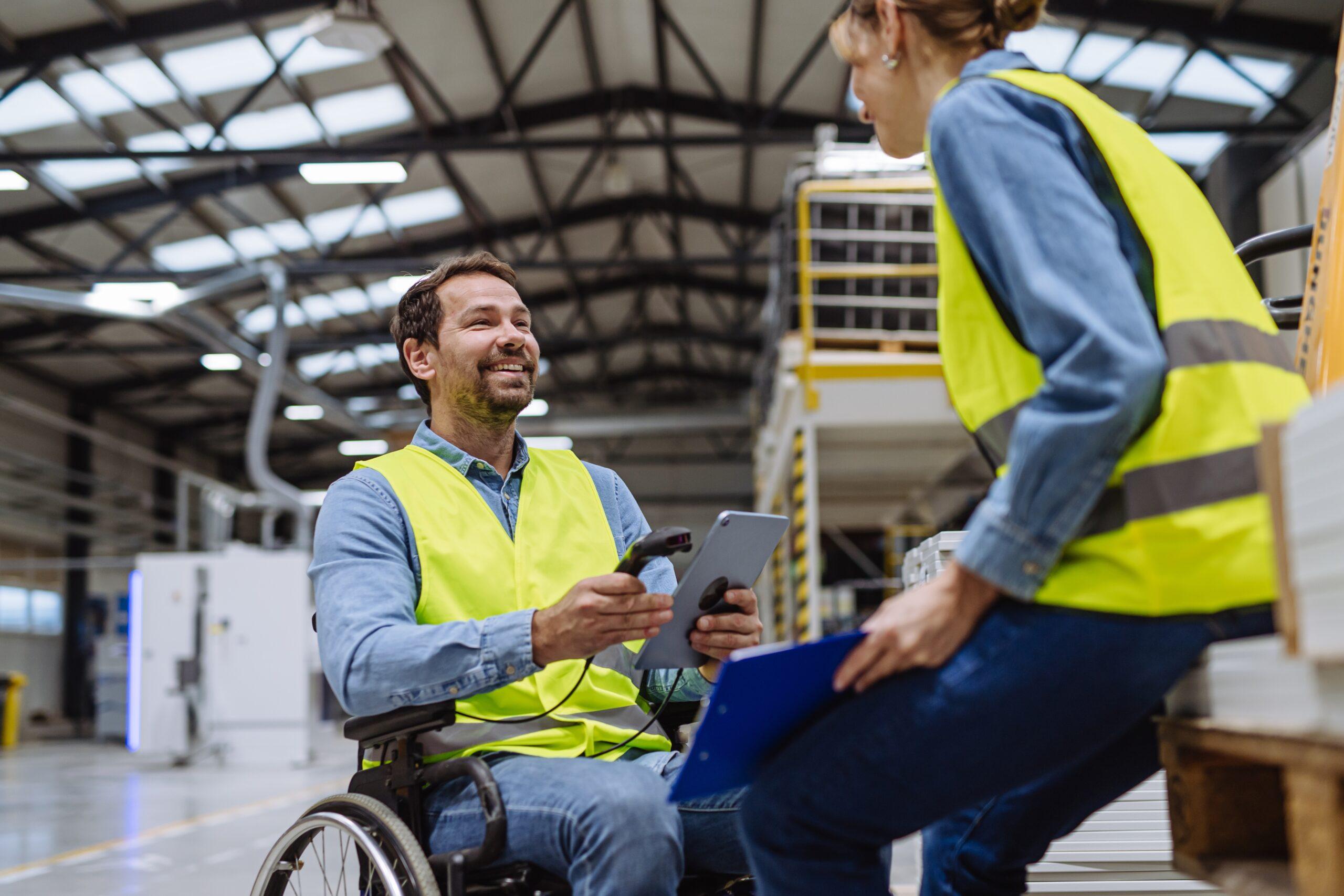
Disability Awareness: Working with People with DisabilitiesCreating an inclusive working environment and workplace is essential for fostering innovation, improving team dynamics, and addressing the evolving needs of today’s workforce. By understanding the challenges faced by people with disabilities and recognizing their unique contributions, learners will gain the skills to support a more diverse and equitable environment. This online course was developed to raise awareness and provide practical strategies to work effectively with people with disabilities.     
Developing a Safety Procedures ManualConsistent safety procedures foster safer working environments, reduce injury-related downtime, and boost productivity. This course will provide participants with the foundation needed to start writing safety procedures that are clear, concise, and practical for day-to-day use. 
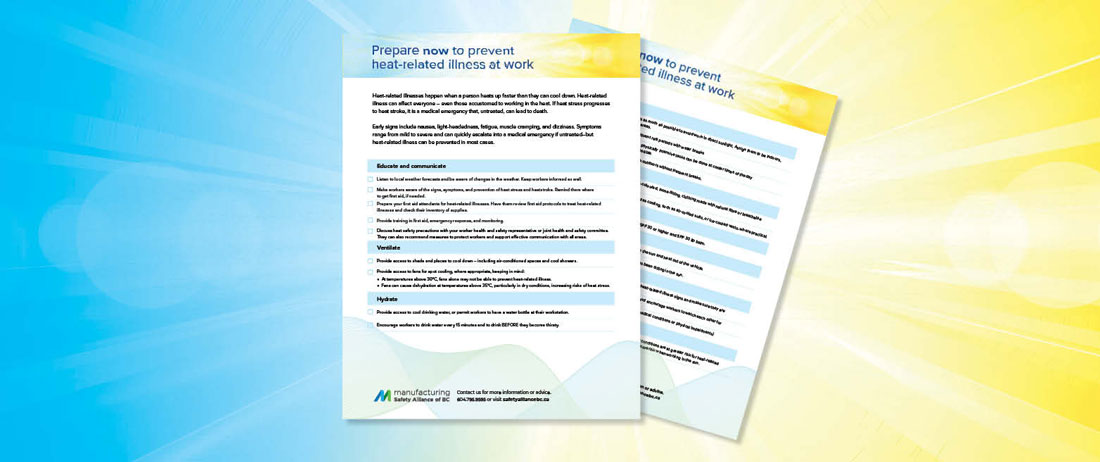
Prepare now to prevent heat-related illness at workHeat-related illnesses happen when a person heats up faster than they can cool down. Heat-related illness can affect everyone – even those accustomed to working in the heat. If heat stress progresses to heat stroke, it is a medical emergency that, untreated, can lead to death.
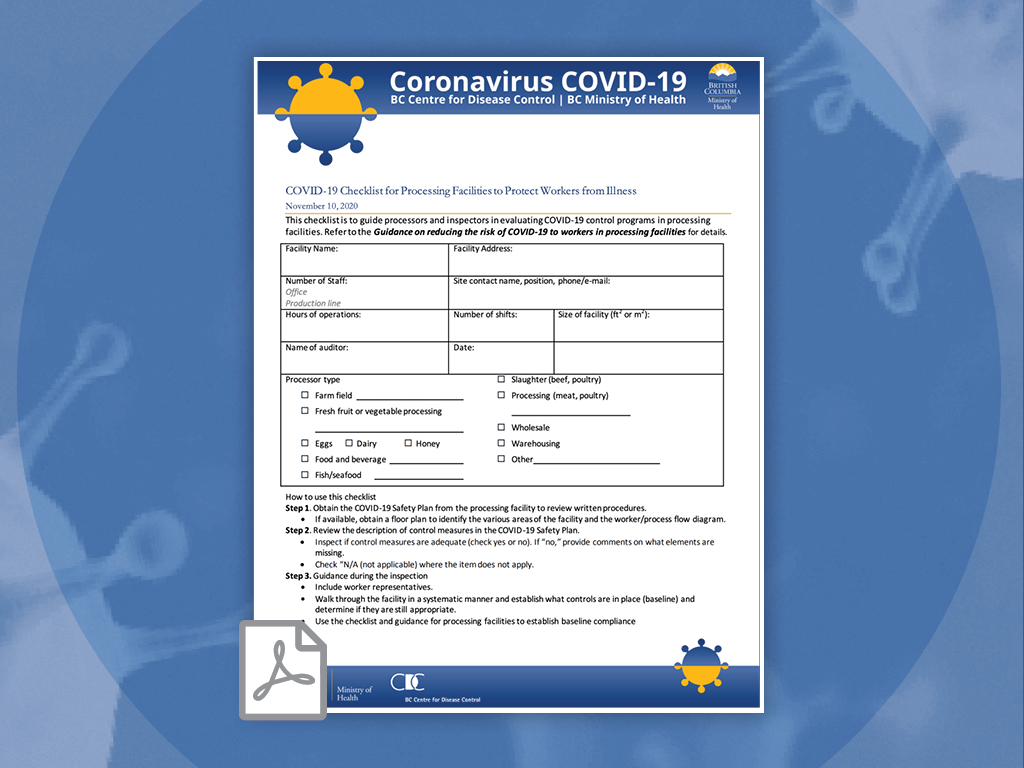
BCCDC COVID-19 Checklist for Processing FacilitiesThis checklist is to guide processors and inspectors in evaluating COVID-19 control programs in processing facilities. Refer to the Guidance on reducing the risk of COVID-19 to workers in processing facilities for details.
Conducting a Hazard Assessment after a floodBusinesses impacted by a flood must take steps to ensure their personal safety and their employees, including a hazard assessment. Do not enter a flood-damaged location without first reviewing the risks and putting protections from potential hazards in place.