Health and Safety

Planned Inspections for Manufacturers and Food Processors in 2024

Who does this impact? WorkSafeBC has announced that in 2024, as part of their Planned Inspections Initiative, they will be focusing inspections on the following manufacturing classification units (CUs). Historically, workers in these CUs are at higher risk for serious injury. 711005—Butter, Cheese, or Ice Cream Manufacture  711010—Fish Processing, Reduction, Canning 711012—Food Product Manufacture 711019—Poultry Processing 712006—Concrete Product Manufacture 712016—Heavy Equipment, Machinery, or Parts Manufacture or Installation (greater than 500 lb.) 712025—Commercial Marine Vessel Manufacture, Service and Repair 712027—Manufacture, or Manufacture and Installation of Structural Metal Products 712028—Metal Product Manufacture 712033—Ready Mix Concrete Manufacture and Delivery 712034—Sheet Metal Fabrication 712035—Smelter 712037—Stone or Marble Cutting, Dressing, Shaping, or Lettering, or Stone or Marble Product Manufacture 712038—Manufacture, or Manufacture and Installation of Structural Concrete Products 713008—Drug, Vitamin, or Pharmaceutical Manufacture 713024—Plastic or Rubber Recycling  714015—Planing Mill 714019—Pellet or Pressed Wood Product Manufacture 714022—Sawmill 714023—Shake or Shingle Mill 714027—Veneer or Plywood Manufacture 714031—Wooden Box, Crate, Pallet, or Lath Manufacture 714032—Wooden Component Manufacture (not elsewhere specified) 714040—Manufacture, or Manufacture and Installation of Wooden Trusses 714042—Woodworking or Carpentry Shop 714044—Pulp and Paper Mill 715020—Glass Shop or Glass Product Manufacture (not elsewhere specified) Top workplace risks and hazards The primary workplace risks and hazards that prevention officers will be looking for in 2024: Musculoskeletal injury (MSI) risks and worker awareness of ergonomics Machine hazards and missing, broken, or inappropriate safeguarding De-energization and lockout Psychological safety awareness (including working alone, bullying and harassment, violence, new and young worker training, first aid, and monthly meetings) Occupational disease, with a highlight on asbestos; (see Initiative details for other disease hazard focus areas) Prevention officers will evaluate an employer’s ability and efforts towards identifying hazards, implementing controls, and effective review and improvement of processes. For more details on specific focus areas, learn more about WorkSafeBC’s: Manufacturing Planned Inspectional Initiative MSI Planned inspectional Initiative Occupational Disease Planned Inspectional Initiative Psychological Health and Safety Planned Inspectional Initiative Are you ready? The Manufacturing Safety Alliance of BC has resources and support to help you strengthen your health and safety strategies in these key focus areas. Training—Consider having your JHSC complete training in Hazard Identification, Incident Investigation, and Workplace Inspections. This will help your health and safety committee identify and recommend controls for the hazards above. MSABC also has a wealth of introductory and awareness courses that provide some basic training and information for all staff. Specialized Services—Our experienced Safety Advisors can work with your teams to identify the gaps in existing health and safety programs. They can help you build a step-by-step action plan to ensure that your business’ health and safety responses meet the mark. Safety Topics and Resources—Download posters and toolbox talks to help keep these workplace hazards top of mind. These resources are available free of charge and can be used in regular staff safety training or shared on-site to increase awareness. To help you find all the associated resources, our safety topics compile resources and training related to a specific workplace hazard into one place. If you need to help figuring out where and how to start, email at manufacturing@safetyalliancebc.ca or call 1.604.795.9595. The training, support, and resources you need Musculoskeletal Injuries Training Ergonomics 101 Ergonomics 102 Expert Advisors and Assessments Dr. Aaron Derouin Ergonomic and Human Factors Assessments Safety Topic and Resources MSI Prevention Safeguarding Training Machine Safeguarding Expert Advisors and Assessments Sasan Tahvili Machine Safeguarding Scoping Safety Topic and Resources Machine Safeguarding De-Energization and Lockout Training De-energization and Lockout Expert Advisors and Assessments Needs Assessment and GAP Analysis Safety Topics and Resources Electrical Safety Lockout/Tagout and Machine Safety Psychological Safety Training Mental Health Awareness Mental Wellness at Work Mental Health Skill Building for Workers Mental Health Management for Leaders Expert Advisors and Assessments Dr. Steve Conway Mental Health Consulting Safety Topic and Resources Mental Health and Wellness Occupational Disease Training Hearing Conservation Respiratory Protection Expert Advisors and Assessments Muhammad Qazi Brendan Talbot Air Quality Assessment Noise Hazards—Surveys and Testing Safety Topic and Resources Personal Protective Equipment Respiratory Protection Wildfire Smoke and Air Quality Hearing Conservation Heat Related Illness Hazard Identification and Control Training Hazard Identification and Control Incident Investigation Workplace Inspections Expert Advisors and Assessments Needs Assessment and GAP Analysis Safety Topic and Resources Workplace Inspections Hazard Identification and Risk Management

Read More »
Working in Cold Environments

Are your employees working in the cold? Understand and address the risks to avoid injury.

With cold temperatures and winter conditions on the horizon, employers have an obligation to keep workers safe from winter-weather hazards. As the temperatures drop, workers in unheated (or refrigerated) areas of your facility – or whose work takes them outside, are at higher risk of injury from a range of potential hazards. As employers, you are responsible for assessing the changing risk profile of your employees’ work environment implementing comprehensive safety measures to minimize the risks. Here are some resources that can help—and your Manufacturing Safety Alliance of BC safety advisor can assist. Contact us for help here. Risk areas to consider: Winter driving hazards Limited visibility and icy conditions result in substantially more motor vehicle accidents during the winter months. The winter months are high season for work-related motor vehicle accidents. If your employees are on the road, do they need to be? Do they have the appropriate tires, training, and knowledge to drive safely in adverse winter conditions? Webinar: The business and social case for managing driving risks Slips and Falls Icy surfaces increase the risk of slips, trips, and falls—which can sideline workers with sprained ankles or wrists or broken bones. What steps have you taken to assess and minimize these risks? Equipment malfunction In cold environments, lubricants can freeze, plastic tools may become brittle, and electronics may malfunction. Is your equipment rated for the lower temperatures? Cold stress A range of cold-related illnesses present a risk to employees in cold and wet environments as we often experience in a B.C. cold snap. Exposed fingers, toes, ears, and noses can be vulnerable to frostbite—and hypothermia can be life-threatening. In the past ten years, WorkSafeBC has accepted 167 claims for disability benefits for injuries related to cold stress. Do your employees have the right clothing to work in cold temperatures? Are they taking adequate breaks to warm up? What health concerns and exposure limits should you be aware of for workers in cold environments? Find out: Call an Alliance safety advisor, occupational hygienist, or ergonomist for advice.  Check out this key fact sheet on risks factors and controls for employees working in the cold. Review the hazard matrix in Environment Canada’s Wind Chill Index page to assess your risk and determine appropriate controls. Driving is the most significant risk for many companies. Visit Shift Into Winter for help.

Read More »
Women in Safety

OHS Canada Feature | Keeping your team safe: Leadership tips for working with subcontractors

Most business leaders recognize their duty to protect workers within the four walls of their operating facilities. Even in recent years, with more employers adapting policies to address remote work, production staff in the manufacturing sector remained onsite. But what if your team provides services and support onsite elsewhere — at a facility you don’t own? What if you employ temporary workers and contract employees? Where do the obligations of contractor and subcontractor begin and end in protecting contract workers’ health and safety? While subcontractors are separate entities, there is a fiduciary responsibility and onus on all businesses to ensure every worker is protected from hazards and risks. And, as business leaders, we are responsible to know what risks we are introducing into our facilities when we hire a contractor or subcontractor and to control those risks effectively. Ultimately, we are responsible for the health and safety of our workers and the contractors and subcontractors who come to work in our facilities—as well as their impact on our risk profile and culture. Health and safety considerations in contractor procurement A sustainable culture of health and safety doesn’t begin and end at our business location’s front door. In procuring contractors, in addition to knowing what services they provide, we need to understand who they are and how they approach workplace health and safety. By considering it upfront in our contractor selection, we can take steps to protect the safety culture in our own operations. Our due diligence includes requiring that proposals including information on the contractor’s health and safety programs — and references confirming that they follow their safe work procedures onsite. As we identify potential contractors and subcontractors, we also need to determine whether their approach aligns with ours. What is their safety performance record? How do they balance the health and safety of their workers with the demands of clients? Have they achieved a safety certification such as COR or the Occupational Safety Standard of Excellence to demonstrate they have a third party audited process to systematically manage OHS risks? Due diligence in answering questions like these provides checks and balances in the selection of contractors whose values align with ours. Oversight and follow-through Whether we work with a subcontractor on a short-term basis or long term, we are entering a partnership. Oversight and follow-through are critical factors in managing this important relationship. By valuing health and safety in the selection and ongoing management of contract workers, we see to the protection and wellness of everyone. This is an expectation and our duty as employers when endorsing contractor agreements. In our management processes, we also need to evaluate and plan for effective orientation, training, and oversight of contractors and subcontractors on-site. And in a longer-term contract arrangement, contractors have a significant impact on our teams and culture. That is an influence we need to recognize and manage. How do we ensure that all workers will have the required safety training? Will required training be upfront or ongoing? Have we assigned an employee to orient, train, manage, and provide oversight to the contractor worker? Could there be benefit in a long-term contractor participating in our joint health and safety committee? With the support of health and safety professionals both at our own companies and at our subcontractors, we can identify the best way to engage each other to minimize risk and strengthen our culture. Continual improvement and review No matter how we work with a contractor or subcontractor, it’s important to identify and agree to an ongoing process of review and refinement — including an assessment of the contractor’s health and safety policies, any incidents involving contract staff, and the influence of the contract workers on employee perceptions of health and safety. Continual improvement is key to ongoing, successful health and safety programs. As we develop and refine our own health and safety programs, we need to look for ways to bring our contractors along. Keep them informed about changes in policies, procedures, physical changes, in the facility, staffing changes, and anything that could impact their safety. Through integration of health and safety into contractor procurement, oversight, and continual improvement, we protect our people and safety culture. Collaboration on health and safety makes our contractor partnerships more effective — and becomes another driver of sustainable business performance. Written by: Lisa McGuire Originally published in the August 2023 Edition of OHS Canada.

Read More »

Meet Workplace Mental Health and Wellness Director Dr. Steven Conway

Mental health problems and illnesses account for 20 percent of sick leaves and 30 percent of disability claims annually (Mental Health Commission of Canada). The cost to the Canadian economy is more than $50 billion annually, also contributing to lost productivity due to absenteeism, presenteeism, and turnover. In 2022, the Manufacturing Safety Alliance of BC introduced a mental health strategy to support food processors and manufacturers. Leading this strategy is new Alliance Mental Health and Wellness Director, Dr. Steven Conway. To learn more, we sat down with Steve to ask him a few questions: Q: What is your role at the Alliance? I’m the Mental Health and Wellness Director. My role, which is new to the Alliance, is to support members in promoting and developing employee mental health and wellness and to direct the implementation our mental health strategy. Q: How will you be supporting members and OSSE-Certified Organizations?  In my role as the Mental Health and Wellness Director, I am available to provide expertise, guidance, and coaching to help leaders, HR professionals, and senior managers incorporate and develop mental health and wellness initiatives. While I will not provide counselling, I am available to consult on specific mental health issues employers may be facing. I will be working with our team at the Alliance and partner organizations to develop a library of high quality and relevant online mental health resources, help facilitate mental health training for members, and introduce a mental health GAP tool for members. Q: How will members be able to access these specialized services? Members can contact me directly, ask for help online, or ask their advisor to connect them with me. Please reach out for any assistance in promoting workplace mental health and wellness. I am happy to help. Q: Will the Alliance be offering more  workplace mental health training in the future? Absolutely! We are currently partnering with the Canadian Mental Health Association (CMHA) to offer courses for executives and leaders. We are also developing our own courses for members that will cover a variety of mental health and wellness related topics.  If members have specific topics of concern for future course development, they can reach out to me directly: Email Steve. For details on upcoming mental health courses and webinars, check out: Shift Away from Workplace Fatigue | Feb 14 @ 10:30am Harassment & Bullying in the Workplace | Feb 22 @ 2:00pm Respond with Respect: Workplace Mental Health Skills for Managers | Feb 28/Mar 23/Apr 6 @ 8:00am-12:00pm Mental Health Consulting    

Read More »
Young Worker

New Minimum-Age Restrictions for Young Worker Regulations in B.C.

Changes to the employment standards regulation to protect vulnerable young workers in British Columbia will take effect January 1, 2023. The Ministry of Labour last week announced the new minimum-age requirements for young workers in a number of manufacturing, construction, and resource-sector jobs. The changes to the employment standard regulations will come into effect in the New Year. Statistically, more than half of serious injuries happen in a worker’s first six months on the job. The cost is high—to employers and the young workers themselves. In the past decade, WorkSafeBC has paid $26.4 million in job-related disability claims for workers aged 16 to 18 at the time of their injuries. For some young workers, those injuries have resulted in life-long disabilities—and 16 have died in the past five years as a result of workplace incidents. To protect young workers, the regulations are changing—applying minimum-age restrictions to the most hazardous jobs for young workers in a variety of industries—including a number in the manufacturing and food processing sectors. Under the new rules, young workers must be at least aged 16 to work in construction or siviculture, as forest firefighters, or in any job from a height that requires fall protection. Young workers will have to be at least aged 18 to work in these jobs: • Forestry: Any job that uses a chainsaw, including tree falling and logging • Metals: In production at a foundry, metal processor or fabricator, refinery or smelter • Pulp and paper: In production at a pulp, paper, shake, shingle, or saw mill • Power: In power-line construction or maintenance where an electrical hazard exists • Oil and gas: oil or gas field servicing and drilling • Food processing: Working with dangerous equipment in fish, meat, or poultry processing And across all industries, young B.C. workers will have to be at least aged 18 to work in any job that involves: • Silica process/exposure to silica dust • The possibility of exposure to potentially harmful levels of asbestos or radiation • Work in a confined space or underground workings • Work requiring a respirator Workers who are within six months of the minimum age on January 1, 2023, will be grandfathered under the new rules. More: Ministry of Labour News Release

Read More »
Vancouver Asbestos Memorial

The Asbestos Memorial

The first monument in North America to honour the thousands who have died (and continue to suffer and die) from asbestos exposure, Vancouver’s Asbestos Memorial was officially dedicated on September 22, 2022. You can see Doug R Taylor’s kinetic sculpture, named “Wind Wheel Mobile,” on the waterfront path at the Vancouver Convention Centre West. We tend to think of workplace health and safety in terms of physical hazards and personal protective equipment. But environmental hazards, mental illness, and occupational disease are significant risks to our businesses and our people. Mesothelioma, an asbestos-related lung disease, remains the leading cause of workplace deaths in our province—and has been responsible for fully one third of all workplace deaths in Canada since 2000. This beautiful piece of public art honours the thousands who have died, and continue to die—including 53 British Columbians in the past year—from asbestos exposure. The memorial is a symbol of the dangers that can hide unseen— in our workplaces and environment, affecting workers sometimes years or decades after their exposure.  Facing Burrard Inlet, where for decades, workers loaded asbestos into ships for export, the memorial is part of the “Line of Work” art installation profiling workers killed and injured on the job. This excellent editorial by B.C. Labour Heritage Centre chair Joey Hartman explains why asbestos remains a significant hazard to B.C. workers and families. And this WorkSafeBC video tells more of the story. Photo credit: BC Labour Heritage Centre

Read More »
Asbestos Safety

Asbestos certification and licensing

The provincial government has amended the Workers Compensation Act to establish requirements that asbestos abatement contractors must be licensed to operate in British Columbia, and that workers and employers who perform this work must complete mandatory safety training and certification. WorkSafeBC is responsible for implementing these requirements. To keep employers informed, WorkSafeBC has released this Quarter 2 update, with an overview of the implementation plan and summary of the job analysis sessions recently conducted with external stakeholders.

Read More »

Hearing loss in the workplace IS preventable – Make hearing conservation an injury prevention strategy

In March, we recognize World Hearing Day (March 3) – an annual global advocacy event that calls for action to address hearing loss. Hearing loss is more common than you might think – an estimated 54 percent of Canadians, ages 40-79, have a least mild hearing loss. Occupational hearing loss can happen when workers are exposed to loud noise or chemicals that affect hearing. Hearing loss isn’t easy to notice, but overexposure to loud noises decreases our ability to hear with time. When you experience excessive noise, damage occurs to tiny sensory cells (microscopic hair cells) deep inside your ear, so there’s no way to see the damage, and there is no pain. We sat down with Alliance Associate member TJs Workplace Hearing Testing to talk about hearing loss in the workplace. How prevalent is hearing loss in the workplace? It is widespread to see hearing loss due to noise in the workplace. In our experience, the risk of noise-induced hearing loss can vary from industry to industry, but the truth remains: noise will cause damage to our ears What are some of the most significant contributors to hearing loss at work? Exposure to machinery noise and improper use of hearing protective devices are two significant contributors to hearing loss on the job. How preventable is workplace hearing loss? Workplace hearing loss is 100% preventable as long as employees make a conscious effort to wear hearing protection correctly. Hearing protection devices, like other PPE – such as safety vests, safety boots, and goggles – minimize the risk of hearing loss and injury in the workplace. What are some of the key things businesses should consider to protect workers’ hearing? Business owners and operators should think of hearing tests as a wellness and health issue instead of a compliance issue. Many companies have employee group benefits for vision and dental coverage – but those plans don’t always cover hearing tests. Hearing tests help prevent and manage hearing loss and are critical for health management, just like vision and dental care. Where do you see opportunities to improve hearing conservation programs in your work with businesses? In our experience, businesses can improve their hearing conservation programs in three ways: Shift their mindset from compliance to wellness when it comes to hearing Have consistent annual hearing tests for workers – especially those regularly exposed to excessive noise on the job Improve their selection of hearing protection devices How critical is PPE/hearing protection in preventing hearing loss? PPE and hearing protection devices are extremely critical to prevent hearing loss in workers. How often should workers have a hearing test? Workers should have their hearing tested at least once a year, just like their regular eye doctor and dentist visits. What’s the single best way to prevent hearing loss? Both employers and workers should collaborate to make noise-induced hearing loss a preventable workplace injury. According to WorkSafeBC, employers can take measures to prevent noise-induced hearing loss through the following: Ensure all workers at risk wear sufficient hearing protection that fits and understands how to wear it properly. Ensure workers insert or wear the appropriate hearing protection before entering a noisy environment and wear it until after exiting the noisy location. Rotate workers to different positions, spending less time in noisy environments. Identify potential engineering controls to mitigate the risk of exposure. Ensure workers have their hearing tested and are aware of their hearing test results. Annual hearing tests and proper use of hearing protection devices can help prevent any further noise-induced hearing loss in the workplace. Wearing appropriate hearing protection should be as habitual as putting on safety boots, glasses, and vests. What are some of the impacts of hearing loss for workers? Hearing loss can significantly change a worker’s quality of life. Workers with hearing loss may miss hearing necessary auditory cues such as forklifts or verbal instructions in the workplace, especially in a noisy environment. Outside of work, hearing loss can lead to social anxiety, depression, and isolation. Tell us how you got started as a company? TJs Hearing started in 2002 as a small, family-owned and operated business working in the industry for close to 20 years. Hearing conservation is achievable. Noise-induced hearing loss is permanent, but it’s also 100% preventable. As a family-owned company, we are proud of our professionalism and efficiency when working with our clients. We are your trusted partner in hearing conservation. Learn more about TJ’s Workplace Hearing Testing on our website. Check out more hearing conservation tools and resources – March’s topic in our 12 months of safety!

Read More »
Responsible Business

Behaviour-Based Safety – Part 1 | Rewards and Penalties

by Pourya Ghani, OH&S Technical Advisor We all know that workplace incidents can have serious human and financial costs for organizations. Most workplace injuries involve an unsafe habit or behavior. Behavioral-based safety (BBS) is a scientific attempt to understand the relationship between human nature and work, and a mechanism to improve.[1] The aim of a BBS program is to change behavior through use of objective measures, results-based changes, and feedback with one goal in mind: to increase safety performance, reducing work-related incidents. Creating a BBS program today can help you see the benefits in your organizational culture sooner than you think.

Read More »
OHS Regulation amendments

New Health and Safety Regulatory Changes | Effective September 1, 2021

New regulatory amendments came into effect on September 1, 2021. Please note the changes to these sections of the Occupational Health and Safety (OHS) Regulation. Pesticides (Part 6) Safety headgear (Part 8) High-visibility apparel (Part 8) Mobile equipment (Part 16) Several OHS guidelines have been created or revised in relation to these amendments. You can find these on the OHS Regulation Updates & Decisions page of the WorkSafeBC website. More information on the amendments These resources explain the amendments overall, and provide more detailed information in primers that cover each of the changes: Overview: Changes to the Occupational Health and Safety Regulation, September 2021 Regulatory amendment: A primer on restricted entry intervals for pesticides Regulatory amendment: A primer on safety headgear Regulatory amendment: A primer on high-visibility apparel Regulatory amendment: A primer on mobile equipment For workers who want to better understand the changes in the regulation around safety headgear (Part 8), Safety headgear: Rights and responsibilities explains, and is also available in Punjabi. If you have questions or need advice regarding the impact of these changes for your workplace, we are happy to help. Call 1-604-795-9595 or email us to talk with a Safety Advisor.

Read More »

Health and safety for small businesses

Regardless of size – protecting worker on the job is the right thing to do In a small business, an employer often wears many hats, and one of those hats is protecting their workers from injury and illness in the workplace. Regardless of their size, employers are legally obligated to keep their workers safe.   “When you first decide to open a new business, you just don’t know that much about your obligations,” said Wayne Arondus, Chief Operations Officer at the Manufacturing Safety Alliance of BC. “You may not know, for example, that once you employ and pay workers – whether regular, casual, or on contract – you must be registered and covered by WorkSafeBC.”  Of the more than 532,000 businesses in B.C., 95 percent (507,600) have fewer than 20 employees—and 83 percent have less than five employees. Western Canada leads the country in the number of small businesses and in small business growth. Between 2014 and 2019, the number of small businesses in B.C. grew 14.4 percent (well over the national average of 7.5 percent).  “Three-quarters of our members in the Alliance are small and micro businesses, and many of them have a huge knowledge gap when it comes to knowing how to keep their employees safe,” Wayne notes. “Our job is to fill that gap for small employers between when they register their business and when WorkSafeBC shows up on their door.”  Wayne recalls a recent experience with a micro employer who experienced a near miss after years without an incident in the workplace. The near miss exposed the fact that there were very few controls in place to manage workplace accidents – including no first aid kit, documentation procedures, or incident investigation capacity.  Unfortunately, the near miss was followed less than a month later with a second accident that resulted in an amputation.    “When you’re a small business, you’re so focused on make money and keeping your business afloat that you don’t know how to start thinking about health and safety,” said Wayne. “By the time you get around to it, it might already be too late to prevent that first accident.” Many small business owners may not be aware that they have a legal obligation to protect their workers. Still, all B.C. companies–even small and micro employers–need to develop health and safety programs that comply with the Workers Compensation Act and the Occupational Health and Safety Regulation. A small business does not need the same formal safety program that a larger company does in most cases, but understanding the fundamental elements is the key to keeping workers safe. Employers with twenty or more workers AND a work environment with a moderate to high risk of injury must establish a formal health and safety program. Depending on the hazards, a WorkSafeBC officer may also determine that a formal and documented occupational health and safety program is necessary even in some small companies. An effective, “informal” OHS program for a small business might include such things as monthly meetings with workers to discuss health and safety matters, regular walkabouts to determine safe work habits are in place, and check-ins with employees to discuss potential risks and hazards in the workplace.  Wayne Arondus, COO Manufacturing Safety Alliance of BC Safety is good business  Small businesses are often so focused on keeping their company afloat that they don’t know how to start thinking about health and safety—but health and safety is good business. Your vendors and customers see the news; a serious accident or death would not only devastate you and your small team—it could also be the factor that makes a customer decide to choose your competitor. That reputation factor is the key reason why some industry contracts even require businesses to take a step further and achieve formal health and safety certification.    In addition, a company that prioritizes health and safety can also experience improved quality of their product or services through increased training, effective communication, worker engagement, and leadership commitment.   Wayne reminds small employers to stop thinking that it will never happen to them. Even small steps like formally investigating accidents and near misses will help ensure they don’t happen again. He adds, “A workplace injury can be life-altering. Do whatever is within your power to create a conversation about safety with your workers.”  Tips for small businesses to create a health and safety culture at work:  Assign someone on your team to help you build and manage your health and safety program basics  Prepare a health and safety policy (check out our Small Business Centre for a template to develop your policy)  Conduct a risk assessment on the activities in your workplace  Regularly inspect your workplace for hazards  Teach workers how to do their jobs safely  Have regular health and safety check-ins with your team  Make health and safety part of your everyday operations  Ask your staff to talk about hazards they see on the job and fix any problems they report  Have adequate first aid equipment – even the smallest company needs a first aid kit on site  Small business centre – a “one-stop-shop” for all your health and safety needs online  The Manufacturing Safety Alliance of BC has a website that provides small businesses with the tools, resources, templates, and training they need to build a successful health and safety management program. Here you will find:  Program essentials to build the foundation of your health and safety program, including:  Information about health and safety legislation in BC Leadership, roles, and responsibilities Hazard ID and risk management Incident investigation Injury reporting Training Workplace inspections Information to take your health and safety program to the next level: Emergency preparedness Ergonomics Fatigue management Mental health OSSE – COR for manufacturing Industry-specific programs and controls: Mobile equipment Combustible dust Industrial storage racking And more…  In addition to the Small Business Centre, two online courses teach small business employers the essentials:  Small Business Fundamentals introduces the basics of occupational health and safety for small businesses in BC Small Employer Building Program teaches the principles and concepts to build an occupational health and safety program  These courses are available, for free, to Alliance small business members.  Register on our website as a small business for FREE access to: FIVE online courses (including Workplace Inspections, Incident Investigation, and Hazard ID) Tools, templates, posters, and resources to build your health and safety program Updates and information on health and safety in the workplace  Visit the small business centre

Read More »

B.C. heat wave puts workers at increased risk for heat-related illness

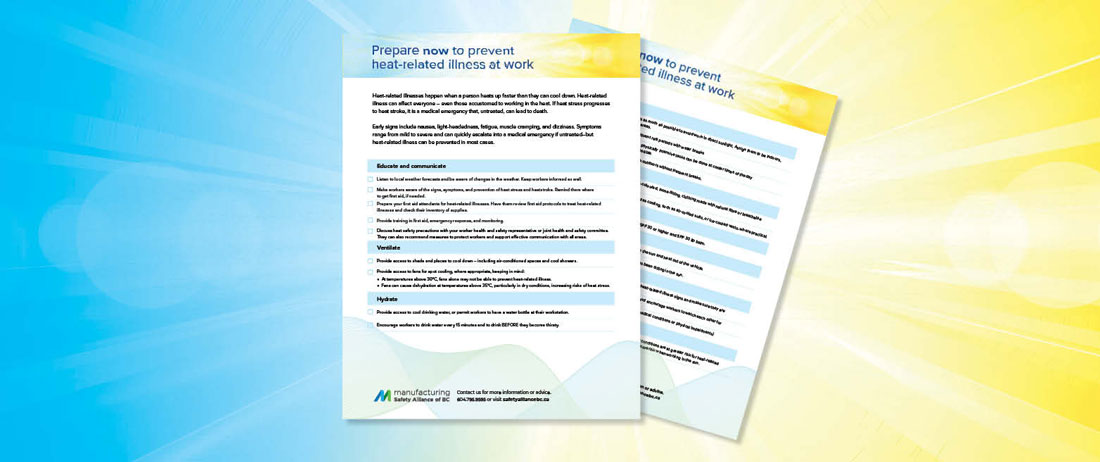
B.C. is bracing for a dangerous, long-duration heat wave. In hot working environments—indoors or out—everyone needs to be alert for the signs and symptoms of heat-related illness and prepare in advance to reduce the risks. Heat-related illnesses happen when a person heats up faster than they can cool down. Symptoms range from mild to severe and can quickly escalate into a medical emergency if untreated—but you can prevent heat-related illness in most cases. Early signs include nausea, light-headedness, fatigue, muscle cramping, and dizziness. Heat-related illness can affect everyone – even those accustomed to working in the heat. If heat exhaustion progresses to heat stroke, it is a medical emergency that, untreated, can lead to death. Prepare NOW to prevent heat-related illness at work EDUCATE AND COMMUNICATE Listen to local weather forecasts and be aware of changes in the weather. Keep workers informed as well. Make workers aware of the signs, symptoms, and prevention of heat stress and heat stroke. Remind them where to get first aid, if needed. Prepare your first aid attendants for heat-related illnesses. Have them review first aid protocols to treat heat-related illnesses and check their inventory of supplies. Provide training in first aid, emergency response, and monitoring. Discuss heat safety precautions with your worker health and safety representative or joint health and safety committee. They can also recommend measures to protect workers and support effective communication with all areas. VENTILATE Provide access to shade and places to cool down – including air-conditioned spaces and cool showers. Provide access to fans for spot cooling, where appropriate, keeping in mind: At temperatures above 30°C, fans alone may not be able to prevent heat-related illness. And at temperatures above 35°C, particularly in dry conditions, fans can cause dehydration, increasing a worker’s risk of heat stress. HYDRATE Provide access to cool drinking water or permit workers to have a water bottle at their workstations. Encourage workers to drink water every 15 minutes and to drink BEFORE they become thirsty. PLAN Avoid scheduling workers outdoors as much as possible to avoid work in direct sunlight. Assign them to be indoors, in shaded areas, or air-conditioned areas. Modify work schedules to include frequent rest periods with water breaks. Consider adjusting hours so that more physically intensive tasks can be done at cooler times of the day—before 10 a.m. or after 4:00 p.m. when possible. Avoid tiring or physically exhausting work outdoors without frequent breaks. DRESS Encourage workers to wear lightweight, light-coloured, loose-fitting clothing. Synthetic fabrics help the skin stay cool through evaporation. Consider offering protective clothing that provides cooling, such as air-cooled suits or ice-cooled vests, where practical. SUN PROTECTION Provide access to broad-spectrum sunscreen with SPF 30 or higher and SPF 30 lip balm. VEHICLES Use sunshades for the windshield and windows to keep the sun and heat out of the vehicle. Remind workers how to cool down their vehicle after it has been sitting in the sun. MONITOR Increase check-ins with workers in hot conditions to monitor heat-related illness signs and make sure they are keeping cool and drinking plenty of water. For employees working outdoors, implement a buddy system and encourage workers to watch each other for symptoms of heat exhaustion. Remember that workers who may be at greater risk (those with medical conditions or physical impairments) may need help to stay cool. KNOW YOUR RISKS Workers with pre-existing conditions such as COPD, asthma, or heart conditions are at greater risk for heat-related illness. Talk to your workers about health issues that may put them at more risk when working in the sun. Download a printable checklist » Download the heat symptoms and first aid infographic » Heat stroke is a medical emergency. If a worker has signs of heat stroke, call 911 or other emergency services immediately.

Read More »
WHMIS EducationThe Workplace Hazardous Materials Information System (WHMIS) education course provides essential training on the safe handling, storage, and disposal of hazardous materials in the workplace. Available in 5 languages: English, Spanish, Punjabi, Mandarin, and Cantonese.
Navigating BC OHS LegislationAs new or experienced safety committee members, managers, or supervisors, it is important to fully understand and know which OHS regulations are related to your work and how you may be in compliance—or not. This 45-minute self-paced course helps introduce people to information on how to identify and find the OHS legislation related their work—perfect for anyone working at a manufacturing or food processing facility who may be tasked with consulting OHS legislation.
Mental Health Skill Building for WorkersIn this 45-minute, self-paced online course, workers learn to identify common signs and symptoms of mental health issues, to recognize stigma and reduce the impact. They learn practical strategies to respond to a co-worker experiencing a mental health issue.
Managing Difficult ConversationsWhether you're working in an environment in-person or virtually, gain practical tools to help you manage difficult conversations effectively to achieve the best possible outcomes through this course.
Hearing ConservationThis awareness level course will introduce learners to the importance of hearing conservation and how to protect themselves from hearing impairment.
Disability Awareness: Working with People with DisabilitiesCreating an inclusive working environment and workplace is essential for fostering innovation, improving team dynamics, and addressing the evolving needs of today’s workforce. By understanding the challenges faced by people with disabilities and recognizing their unique contributions, learners will gain the skills to support a more diverse and equitable environment. This online course was developed to raise awareness and provide practical strategies to work effectively with people with disabilities.     
Developing a Safety Procedures ManualConsistent safety procedures foster safer working environments, reduce injury-related downtime, and boost productivity. This course will provide participants with the foundation needed to start writing safety procedures that are clear, concise, and practical for day-to-day use. 
Prepare now to prevent heat-related illness at workHeat-related illnesses happen when a person heats up faster than they can cool down. Heat-related illness can affect everyone – even those accustomed to working in the heat. If heat stress progresses to heat stroke, it is a medical emergency that, untreated, can lead to death.
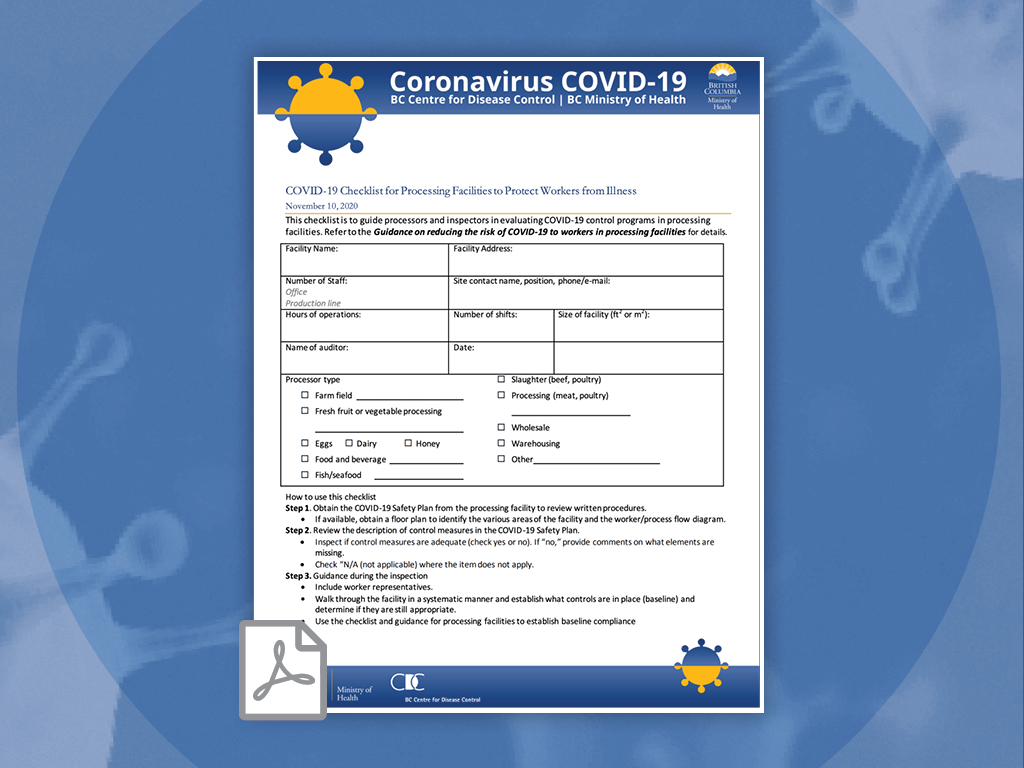
BCCDC COVID-19 Checklist for Processing FacilitiesThis checklist is to guide processors and inspectors in evaluating COVID-19 control programs in processing facilities. Refer to the Guidance on reducing the risk of COVID-19 to workers in processing facilities for details.